2026-05-19 名古屋大学
<関連情報>
- https://www.nagoya-u.ac.jp/researchinfo/result/2026/05/post-994.html
- https://www.nature.com/articles/s41467-026-72573-8
植物における銅依存性酸化還元反応に基づく過酸化水素の認識 A copper-dependent redox-based hydrogen peroxide perception in plants
Nobuaki Ishihama,Yohta Fukuda,Yumiko Shirano,Kazuhiro J. Fujimoto,Kaori Takizawa,Ryoko Hiroyama,Hiroki Ito,Mayumi Nishimura,Takeshi Yanai,Tsuyoshi Inoue,Ken Shirasu & Anuphon Laohavisit
Nature Communications Published:18 May 2026
DOI:https://doi.org/10.1038/s41467-026-72573-8
Abstract
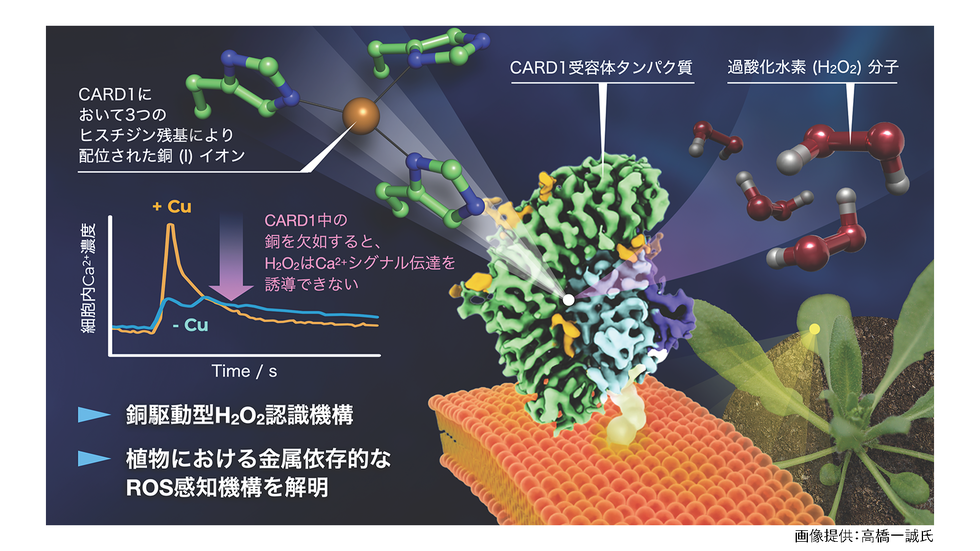
Redox-related molecules, such as quinones and reactive oxygen species (ROS), are important signaling molecules for all living organisms. A plant-specific leucine-rich repeat receptor-like kinase (LRR-RLK) CANNOT RESPOND TO DMBQ 1 (CARD1), also known as HYDROGEN-PEROXIDE-INDUCED Ca2+ INCREASES (HPCA1), perceives both quinones and ROS, but the mechanism by which it distinguishes between these two types of signals remains unclear. Here, we determine the structure of the CARD1 ectodomain and uncover its unique features. Structural studies, coupled with genetics and biochemical analysis, demonstrate that previously identified unique cysteine residues are not essential for signal perception in CARD1. Interestingly, CARD1 harbors a copper ion on the surface of the ectodomain via histidine-coordination that is crucial for hydrogen peroxide signaling. Our work reports a unique copper-dependent redox perception in plants and provides insight into interactions between receptors and non-peptide stimuli during perception.