2026-05-19 東京大学
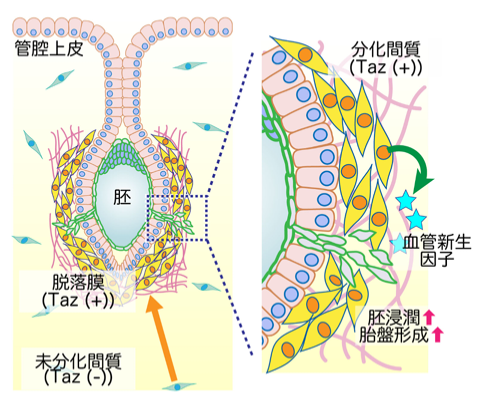
TAZ による脱落膜形成と妊娠制御
<関連情報>
- https://www.h.u-tokyo.ac.jp/press/20260519.html
- https://www.h.u-tokyo.ac.jp/press/__icsFiles/afieldfile/2026/05/19/release_20260519.pdf
- https://www.pnas.org/doi/10.1073/pnas.2528309123
TAZはECMリモデリングと子宮間質分化を統合し、妊娠初期の維持に寄与する TAZ integrates ECM remodeling with uterine stromal differentiation to maintain early pregnancy
Xueting He, Shizu Aikawa, Yamato Fukui, +5 , and Yasushi Hirota
Proceedings of the National Academy of Sciences Published:May 19, 2026
DOI:https://doi.org/10.1073/pnas.2528309123
Significance
Early pregnancy loss and fetal growth restriction frequently arise from poorly formed decidua, yet upstream regulators remain unclear. Integrating single-cell RNA-seq from patients and mouse models with spatial mapping, we show that the Hippo effector TAZ coordinates extracellular matrix (ECM) remodeling required for uterine stromal differentiation. Uterine TAZ deletion precipitates decidual failure, disrupted vascularization, and compromised trophoblast invasion, culminating in subfertility. This cross-species evidence suggests TAZ as a conserved gatekeeper of the uterine microenvironment and highlights ECM dynamics as a mechanistic driver of implantation success. Our study provides a framework for TAZ and its ECM program as candidate biomarkers and intervention targets for disorders of early pregnancy.
Abstract
The uterine microenvironment is critical for establishing pregnancy and sustaining embryonic development. Embryo attachment induces profound endometrial transformation, including stromal differentiation and vascularization, termed decidualization. This process, conserved in humans and rodents, supports the embryo even before placentation. Poorly formed decidua leads to fetal growth restriction or placental defects, yet underlying mechanisms remain unclear. Here, we used single-cell RNA-seq of mouse and human endometria, including patient samples, to uncover key regulators. We identified that collagen-related extracellular matrix (ECM) remodeling depends on TAZ, a central effector of Hippo signaling, and is essential for decidual formation. ECM pathways were enriched in differentiating stromal cells alongside upregulation of TAZ and associated transcription factors. Conditional uterine knockout of TAZ (Wwtr1flox/floxPgrCre/+; Wwtr1-uKO) caused pregnancy failure in mice, marked by defective trophoblast invasion, early embryonic degradation, and severe subfertility. Spatial transcriptomic and histological analyses of TAZ-deficient endometria further revealed impaired decidualization, ECM remodeling, and vascularization. Thus, TAZ promotes temporal ECM remodeling at the feto–maternal interface, ensuring functional decidual zone formation and healthy pregnancy outcomes.