2026-06-01 北海道大学
<関連情報>
- https://www.hokudai.ac.jp/news/2026/06/post-2305.html
- https://www.sciencedirect.com/science/article/pii/S0022283626002299
Guillardia theta由来アニオンチャネルロドプシン1におけるプロトン共役型ゲート閉鎖機構 Proton-Coupled Gate Closing Mechanism in Guillardia theta Anion Channelrhodopsin 1
Miu Sudo, Sayo Inoko, Yuma Ito, Takuma Watanabe, Arisa Idenawa, Yuya Ohki, Keiko Ogawa, Makoto Demura, Hideki Kandori, Takashi Kikukawa, Yuji Furutani, Takashi Tsukamoto
Journal of Molecular Biology Available online: 12 May 2026
DOI:https://doi.org/10.1016/j.jmb.2026.169856
Highlights
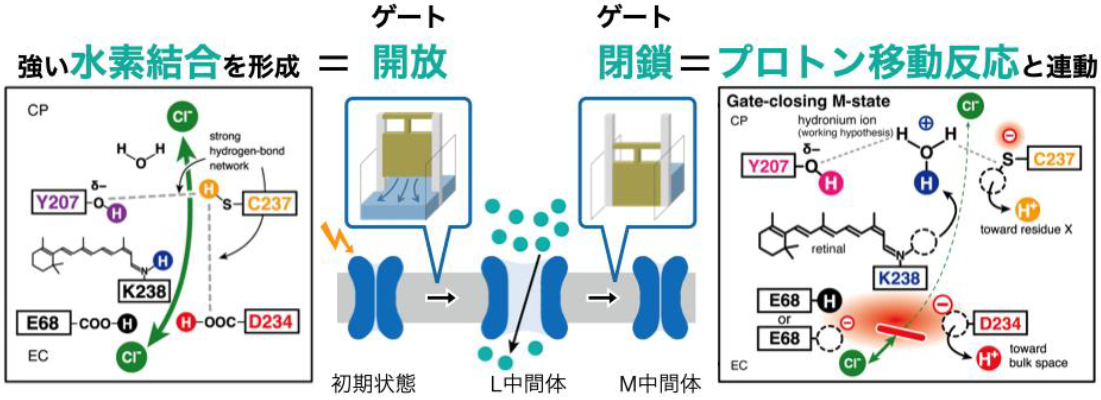
- Proton-coupled reactions are associated with gate closure in GtACR1.
- Asp234 releases a proton during formation of the fast gate-closing M-intermediate.
- Protonation states of key residues in the dark state are clarified in GtACR1.
- Tyr207 and Cys237 modulate retinal Schiff base deprotonation.
- Gate opening and closure are mechanistically interconnected.
Abstract
Light-gated anion channelrhodopsins are widely used as optogenetic silencers, yet the molecular events underlying gate opening and closing remain unclear. Here we show that gate closure in Guillardia theta anion channelrhodopsin 1 (GtACR1) is tightly coupled to coordinated proton-transfer reactions. Time-resolved spectroscopic and electrochemical analyses reveal that formation of the M-intermediate, which governs gate closure, involves not only deprotonation of the retinal Schiff base but also proton release from Asp234 to the extracellular side. We further demonstrate that residues Tyr207 and Cys237 participate in a hydrogen-bond network that modulates retinal Schiff base deprotonation, with Cys237 undergoing deprotonation during M-intermediate formation. In addition, analyses of the dark state provide new experimental evidence regarding the protonation states of functionally important residues in GtACR1, while characterization of the L-intermediate reveals hydrogen-bond rearrangements associated with channel activation. Together, these findings support a mechanistic model in which proton transfer reactions involving Asp234, Tyr207, and Cys237 coordinate retinal Schiff base deprotonation, thereby driving gate closure in GtACR1.