2026-06-03 オックスフォード大学
<関連情報>
- https://www.ox.ac.uk/news/2026-06-01-new-type-of-inhibitor-could-help-tackle-resistance-against-last-resort-antibiotics
- https://pubs.acs.org/doi/10.1021/acs.jmedchem.5c03534
広範囲のメタロβ-ラクタマーゼ阻害剤としての、水を捕捉するピロール-2-カルボン酸の開発 Development of Water-Trapping Pyrrole-2-carboxylic Acids as Broad-Spectrum Metallo-β-lactamase Inhibitors
Monisha SinghaLiam A. Wilson,Elisabete C. C. M. Moura,Maria M. Trush,Karina Calvopina,Gurleen Kaur,Greta Zaborskytė,Toms Kalniņš,Tharindi Panduwawala,Matthew J. Bowen,Matthew J. Beech,Jürgen Brem,Peter J. McHugh,Edgars Suna,Timothy R. Walsh,Christopher J. Schofield,and Alistair J. M. Farley
Journal of Medical Chemistry Published: May 14, 2026
DOI:https://doi.org/10.1021/acs.jmedchem.5c03534
Abstract
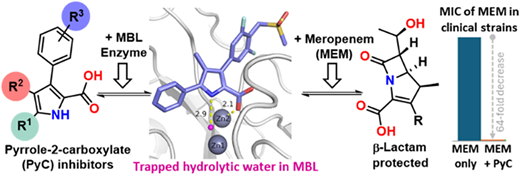
Use of the clinically vital β-lactam antibiotics is increasingly compromised by resistance, commonly mediated by β-lactamases. While clinically used serine-β-lactamase (SBL) inhibitors have long been available, metallo-β-lactamase (MBL) inhibitors are not yet approved for clinical use. We report the structure-guided development of pyrrole-2-carboxylic acid derivatives as potent inhibitors of the clinically important di-Zn(II) ion containing B1 MBLs (NDM-1, VIM-1, VIM-2, IMP-1). Crystallographic studies reveal the pyrrole-2-carboxylic acids inhibit B1 MBLs via active site Zn(II)-coordination of the inhibitor carboxylate and trapping of the di-Zn(II) ion bridging hydroxide, the latter of which reacts with the substrate β-lactam ring during hydrolysis. Appropriately derivatized pyrrole-2-carboxylic acids enhance the activity of carbapenems against MBL producing Gram-negative clinical isolates. The results support further development of metalloenzyme inhibitors that exploit binding to structural or catalytically important water molecules, an approach which may help in achieving selectivity over other metalloenzymes compared to metal-chelation based approaches.