2026-04-21 中国科学院(CAS)
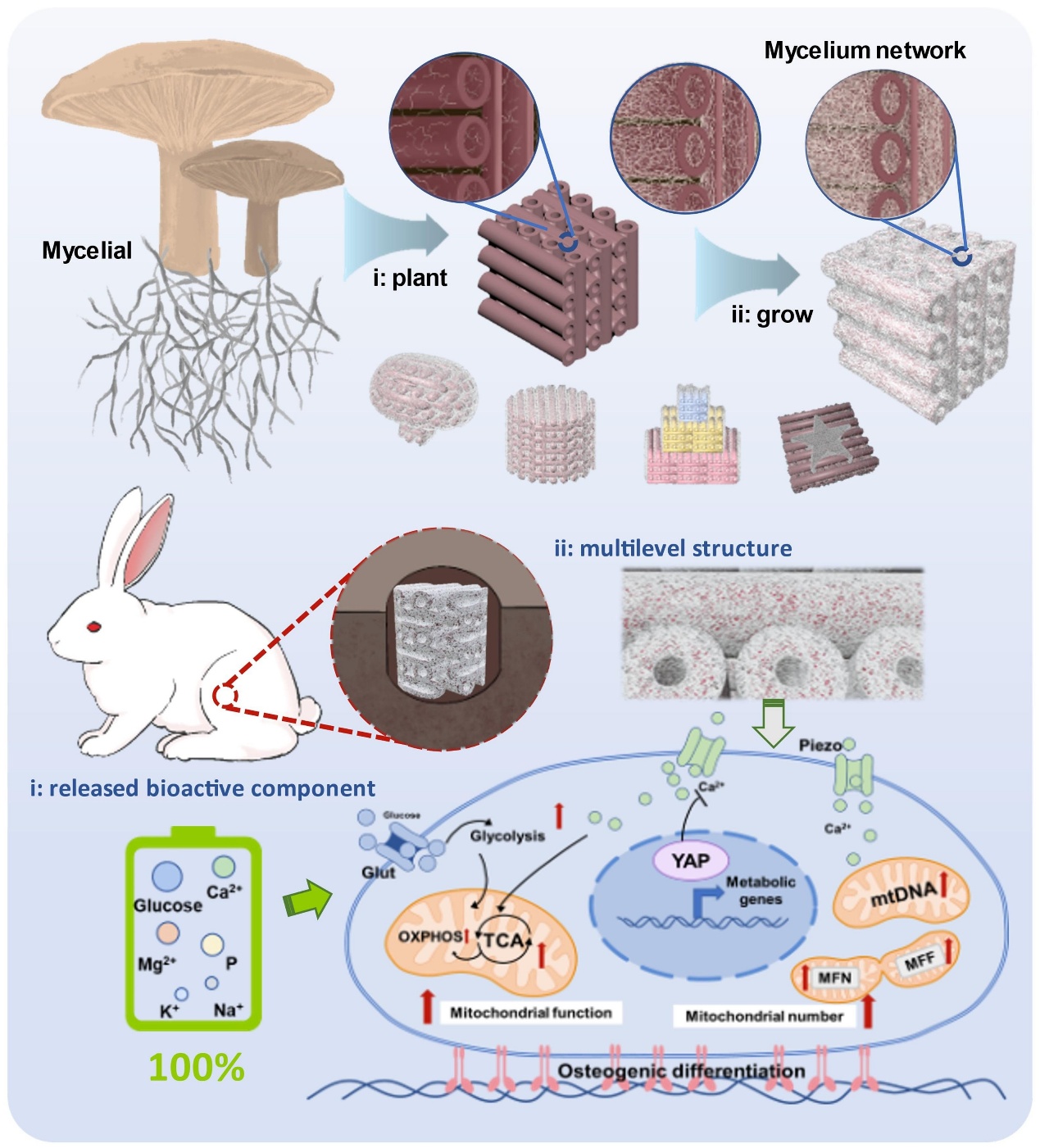
Schematic diagram of the design, fabrication, and application of mycelial bioceramic scaffolds for modulating energy metabolism in bone regeneration. (Image by SIC)
<関連情報>
- https://english.cas.cn/newsroom/research-news/202606/t20260605_1161307.shtml
- https://advanced.onlinelibrary.wiley.com/doi/10.1002/adma.202516328
生体模倣共生工学:菌糸体バイオセラミックスによるエネルギー代謝の活性化と骨形成促進 Biomimetic Symbiotic Engineering: Mycelial Bioceramics to Activate Energy Metabolism for Enhanced Osteogenesis
Jiyi Huang, Shijie Cao, Wenping Ma, Zhibo Yang, Yahui Han, Xiaopeng Yu, Jianmin Xue, Hongxu Lu, Hongshi Ma, Chengtie Wu
Advanced Materials Published: 21 April 2026
DOI:https://doi.org/10.1002/adma.202516328
ABSTRACT
The repair of bone defects remains a considerable challenge, primarily due to the lack of biomimetic hierarchical structures and the insufficient supply of bioenergy in implants. Inspired by the symbiotic structural relationship between mycelium and plants, we developed a biomimetic engineering strategy to construct mycelial bioceramics. This strategy enabled directing the growth of mycelium within bioceramic scaffolds, resulting in the spontaneous generation of a hierarchical structure. Such a hierarchical structure was attributed to the spontaneously microscale porous network of mycelium and the channel structure of the three-dimensional (3D) printed bioceramic scaffold. In addition, the mycelial bioceramics could release a variety of bioactive components, including glucose, calcium ions, and other ions. Hierarchical structure and bioactive components synergistically promoted cellular energy metabolism and osteogenic differentiation by enhancing glycolysis and the oxidative phosphorylation (OXPHOS) process. Furthermore, the mycelial bioceramics effectively activated the YAP/Piezo pathway, driving key mitochondrial biogenesis processes. The siYAP experiment combined with mRNA sequencing demonstrated that the elevated energy metabolism subsequently regulated osteogenic differentiation via PI3K-AKT signaling. In vivo studies using a rabbit femoral defect model demonstrated that mycelial bioceramics could improve cellular energy metabolism and ultimately enhance osteogenesis. In conclusion, the mycelial symbiotic strategy presents a novel approach in designing functional bioceramics for accelerating bone regeneration. Moreover, it may shed light on harnessing microorganisms for tissue engineering and regenerative medicine.