2026-06-08 中国科学院(CAS)
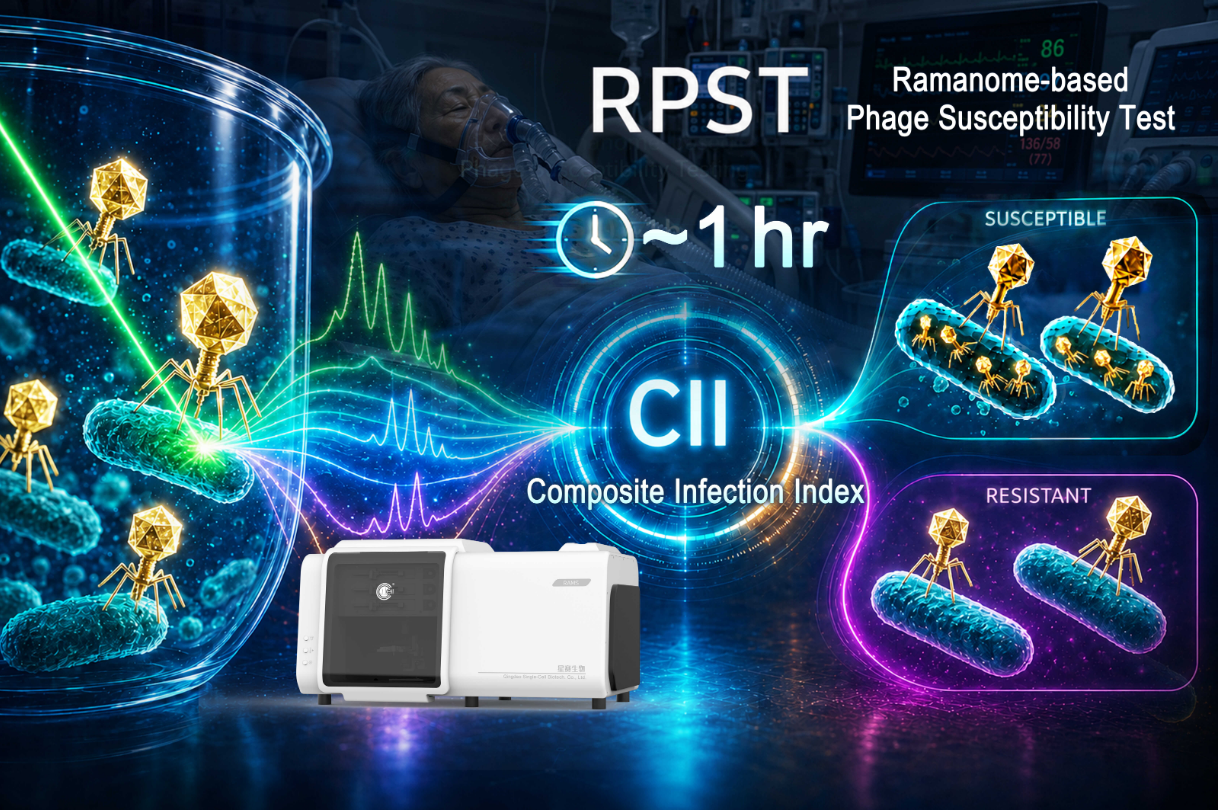
Overview of ramanome-based phage susceptibility test (Image by LIU Yang)
<関連情報>
- https://english.cas.cn/newsroom/research-news/202606/t20260608_1161380.shtml
- https://onlinelibrary.wiley.com/doi/10.1002/mlf2.70089
ラマノームによる迅速かつ定量的なファージ感受性試験 Rapid and quantitative phage susceptibility test by ramanome
Xiao Han, Xiaofu Wan, Yang Zhou, Xiaoting Fu, Xiaoshan Zheng, Bo Gao, Shi Huang, Anle Ge, Jiadong Huang, Hongzhou Lu, Jian Xu
mLife Published: 21 May 2026
DOI:https://doi.org/10.1002/mlf2.70089
Abstract
Antimicrobial resistance poses an escalating global threat, renewing interest in bacteriophage therapy as a precision alternative to antibiotics. However, clinical translation remains hindered by the lack of rapid and quantitative phage susceptibility testing (PST) platforms capable of evaluating host range, infection potency, and effective multiplicity of infection (MOI). Here, we present a ramanome-based phage susceptibility test (RPST), a phenotypic platform that captures infection-induced remodeling of bacterial macromolecular composition to unify these diagnostic requirements within a single workflow. RPST integrates four Raman biomarkers into a Composite Infection Index (CII), enabling rapid and lysis-independent discrimination between susceptible and resistant bacterial populations within ~1 h, with 96.0% categorical concordance (24/25) to plaque assays. As a continuous population-level metric, CII quantifies the proportion of infected cells, allowing quantitative ranking of phage potency against shared hosts. By resolving CII trajectories across the MOI and time, RPST further determines the minimal effective MOI, which is the lowest phage-to-bacterium ratio sustaining self-propagating infection, thereby defining the lower boundary for therapeutic feasibility. Together, these capabilities transform PST from static compatibility assays into a dynamic and quantitative framework that bridges in vitro infectivity assessment and infection dynamics relevant to phage therapy.