2026-06-10 東北大学
◆研究では、マイクロ流体デバイスを用いて細胞に近い大きさの微小油中水滴を作製し、タンパク質液滴の凝集過程を詳細に観察した。その結果、液滴は安定なアミロイド線維だけでなく、準安定なアモルファス凝集体にも変化し、両者が競合することを発見した。特に小さな液滴ではアモルファス凝集体が先に形成されやすく、アミロイド線維形成が抑制されることが定量的に示された。これは細胞内のような微小空間では、従来の試験管実験では見えにくかった準安定状態が重要な役割を果たすことを意味する。
◆本成果は、神経変性疾患に関わるタンパク質凝集機構の理解を深めるとともに、新たな創薬評価法や治療戦略の開発につながることが期待される。
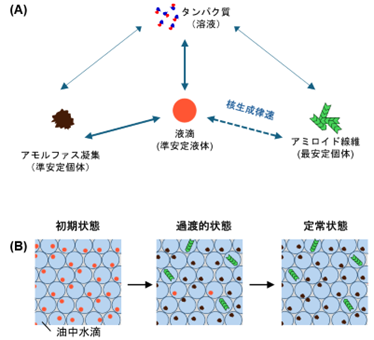
図1. 研究の概要。タンパク質液滴は、安定なアミロイド線維と、準安定なアモルファス凝集体のどちらにも変化します(A)。微小油中水滴に閉じ込めることで、両者の競合を一つ一つ観察できます(B)。
<関連情報>
- https://www.tohoku.ac.jp/japanese/2026/06/press20260610-04-amyloid.html
- https://pubs.acs.org/doi/10.1021/jacs.6c02816
生体分子凝縮物のサイズが、非晶質-アミロイド競合を介した液相-固相転移の運命を決定する Size of Biomolecular Condensates Dictates Fate in Liquid–Solid Phase Transitions through Amorphous–Amyloid Competition
Junka Kawakami,Taiki Ozawa,Yoko Maruyama,Honoka Ishikawa,Yuto Oshita,Kota Yamauchi,Koichi Kobayashi,Shinji Kajimoto,Takakazu Nakabayashi,Shunsuke Tomita,Tanushree Agarwal,Tomas Sneideris,Kichitaro Nakajima,Kentaro Shiraki,Hideki Taguchi,Akihide Hibara,Tuomas Knowles,Eri Chatani,Yuta Mizuno,Yumiko Ohhashi,and Mao Fukuyama
Journal of the American Chemical Society Publishe June 6, 2026
DOI:https://doi.org/10.1021/jacs.6c02816
Abstract
Proteins function not only through intramolecular folding and intermolecular complex formation but also through phase transitions driven by intermolecular interactions. Such phases, including liquid-like condensates, amorphous aggregates (AAs), and amyloid fibrils, are linked to distinct biological functions and pathologies. Although the transition from liquid-like condensates to amyloids has been extensively studied, the kinetic relationships between amyloids and other metastable solid states under cell-sized confinement remain unclear, which may hinder the establishment of effective therapeutic strategies. This knowledge gap arises because bulk-scale experiments inevitably lead to the conversion of metastable phases into the most stable phase. We developed a droplet-based microfluidic system that quantifies amyloid nucleation and metastable AA formation. Using the yeast prion protein Sup35, we found that condensates convert into both amyloids and AAs and that AA formation imposes a kinetic barrier that suppresses amyloid formation in a size-dependent manner at the micrometer scale, highlighting the importance of size effects in condensate-to-amyloid transitions. Furthermore, we demonstrated that the well-known amyloid inhibitor (−)-epigallocatechin-3-gallate paradoxically promoted amyloid formation at low concentrations by modulating the AA and amyloid nucleation kinetics. This phenomenon cannot, in principle, be observed in bulk-scale experiments and became apparent only under micrometer-scale confinement in the present system. These findings provide fundamental insights into protein phase transitions in cellular environments and may guide the development of novel therapeutic strategies targeting the metastable aggregates of amyloidogenic proteins.