2026-06-11 中国科学院(CAS)
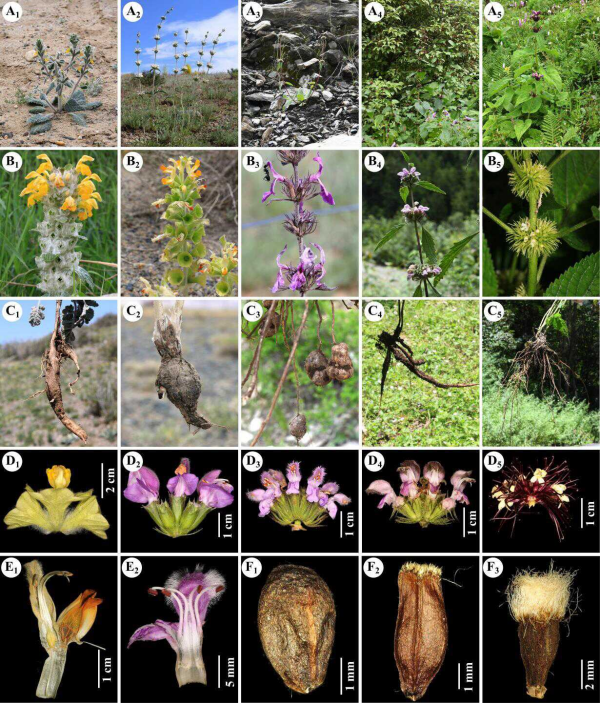
Habitat and morphological diversity of Phlomoides. (Image by XIEG)
<関連情報>
- https://english.cas.cn/newsroom/research-news/202606/t20260611_1161697.shtml
- https://www.sciencedirect.com/science/article/pii/S2468265926001228
葉緑体ゲノムに基づくPhlomoides属(シソ科、シソ亜科)のグローバル系統樹:属内分類、形質進化、生物地理、および多様化に関する考察 A global phylogeny of Phlomoides (Lamiaceae, Lamioideae) based on chloroplast genomes: insights into infrageneric classification, character evolution, biogeography, and diversification
Yue Zhao (赵越), Hairulnisahan Abdurahman (海如丽尼萨罕·阿卜杜热合曼), Francis J. Nge, Orzimat T. Turginov, Alan J. Paton, Maxim S. Nuraliev, Yasaman Salmaki, Dan-Hui Liu (刘丹辉), Ferhat Celep, Ming-Le Li (李明乐), Wen-Jun Li (李文军), Chun-Lei Xiang (向春雷)
Plant Diversity Available online: 21 May 2026
DOI:https://doi.org/10.1016/j.pld.2026.05.006
Highlights
- We present the first global phylogeny of Phlomoides based on dense taxon sampling, covering approximately 73% of the recognized species.
- The monophyly of Phlomoides is strongly supported, and six well-supported major clades are identified, each characterized by potential synapomorphies inferred from morphological evidence.
- Biogeographic reconstruction suggests a Middle Miocene (∼17.7 Ma) origin in the Hengduan Mountains or Central Asia.
- Key morphological traits are associated with drought adaptation; the evolution of leaf complexity may have facilitated adaptive radiation, and ecological niche divergence likely drove major lineage diversification.
ABSTRACT
Being the second largest genus in the subfamily Lamioideae (Lamiaceae), Phlomoides comprises approximately 180 species distributed mainly across Eurasia, with diversity centers in Central Asia, the Iranian Plateau, the Hengduan Mountains, and the Himalayas. Previous phylogenetic studies have expanded Phlomoides to include seven traditionally recognized genera and one section of Phlomis. However, limited taxon sampling and geographical coverage have hindered the establishment of a robust infrageneric classification and left key questions regarding its origin, dispersal, and adaptive evolution across heterogeneous habitats unresolved. In this study, we reconstructed the phylogeny of Phlomoides using whole chloroplast genome data and two nuclear DNA regions (ETS and ITS), based on dense sampling that includes 132 species (73% of the genus). Our dataset comprises 206 chloroplast genomes, 154 of which were newly sequenced. Our major findings are: 1) Phlomoides (as currently defined) is monophyletic and subdivided into six well-supported clades, each exhibiting potential morphological synapomorphies; 2) biogeographical reconstruction suggests that Phlomoides originated in the Hengduan Mountains or Central Asia during the Middle Miocene; 3) pinnatipartite leaves, trichomes on mericarps apex, and tuberous roots are likely associated with drought adaptation; and 4) clades exhibit pronounced ecological niche differentiation, particularly with respect to annual precipitation and temperature range, which may have driven divergence into two major clades. This study provides new insights into the evolutionary dynamics and ecological drivers of plant diversification across Eurasia and highlights adaptive strategies in response to climate change.