2026-06-10 ノースウェスタン大学
<関連情報>
- https://news.northwestern.edu/stories/2026/06/why-plastic-lingers-water-chemistry-slows-natures-cleanup
- https://www.nature.com/articles/s41529-026-00788-7
自然水中におけるポリスチレンの光酸化は、微生物分解の前段階となる Polystyrene photooxidation in natural waters as a precursor to microbial degradation
Nasrin Naderi Beni,Cara G. Flynn & Ludmilla Aristilde
npj Materials Degradation Published:16 June 2026
DOI:https://doi.org/10.1038/s41529-026-00788-7
Abstract
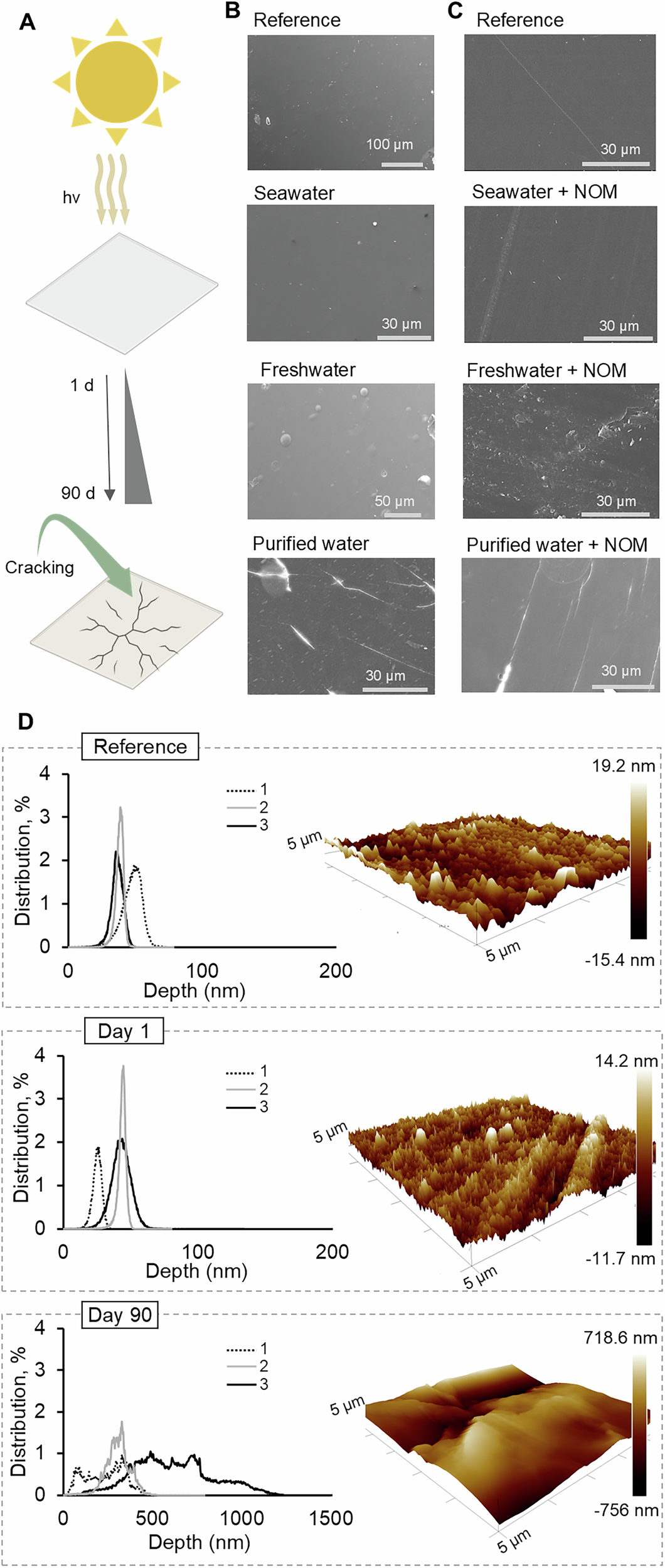
Sunlight exposure and water chemistry are critical to the fate of plastics in surface waters, but conditions in laboratory studies are often not environmentally relevant. Here, we conducted a 3-month investigation of sunlight-simulated photodegradation of polystyrene films in synthetic freshwater and synthetic seawater solutions, compared with purified water. Scanning electron and atomic force microscopic analyses revealed the least photo-induced cracking of the films in the seawater solution compared to the other solutions. By monitoring surface functional groups by infrared spectroscopy and by-products in solution by high-resolution liquid chromatography-mass spectrometry, we obtained experimental evidence for these proposed mechanistic steps in polystyrene photooxidation: emergence of C–O feature, carbonyl accumulation, chain scission, and generation of aromatic acids. The addition of natural dissolved organic matter suppressed photooxidation in freshwater and seawater solutions but enhanced it in purified water. Importantly, subsequent bacterial deterioration of simulated sunlight-exposed polystyrene films was positively correlated with the extent of antecedent photodegradation, which was greater in the freshwater than in the seawater solution. In sum, our findings highlight that electrolytes and organic matter in natural waters interfere with both abiotic and biotic processes of polystyrene degradation, thereby resulting in the environmental persistence of these plastics.