2026-06-22 東京科学大学
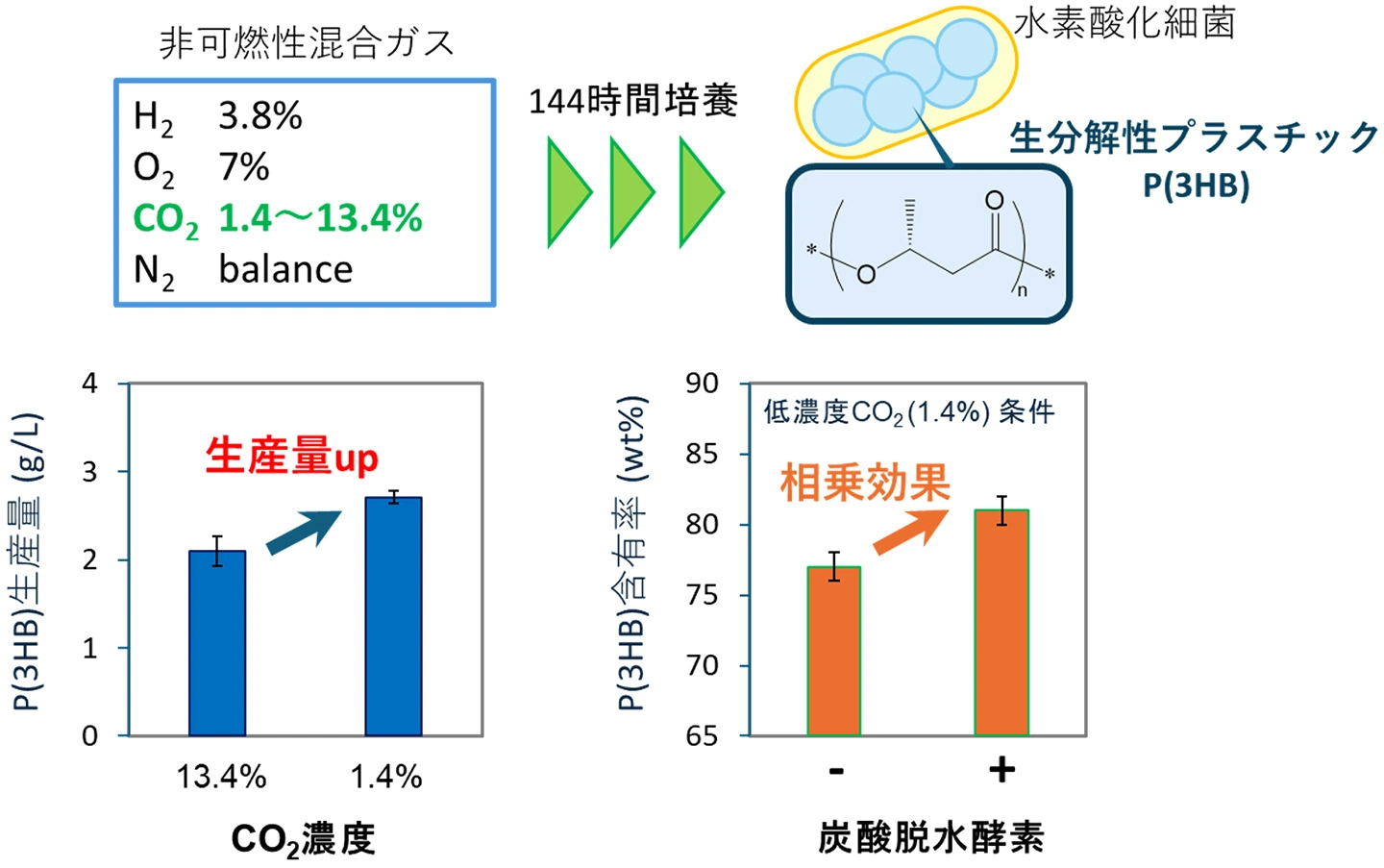
図1. 研究の内容を示す概念図
<関連情報>
- https://www.isct.ac.jp/ja/news/npuc9m483k2s#top
- https://pubs.acs.org/doi/10.1021/acssuschemeng.6c00126
低CO2濃度がラルストニア・ユートロファH16によるポリ[(R)-3-ヒドロキシ酪酸]の独立栄養生産に及ぼす影響と炭酸脱水酵素の相乗効果 Impact of Low CO2 Concentration on Autotrophic Production of Poly[(R)-3-hydroxybutyrate] by Ralstonia eutropha H16 and Synergistic Effect of Carbonic Anhydrase
Chih-Ting Wang,Ramamoorthi M. Sivashankari,Yuki Miyahara,and Takeharu Tsuge
ACS Sustainable Chemistry & Engineering :Published April 16, 2026
DOI:https://doi.org/10.1021/acssuschemeng.6c00126
Abstract
Polyhydroxyalkanoates (PHAs) are bacterial polyesters, and poly[(R)-3-hydroxybutyrate] [P(3HB)] is a member of PHAs, with promising applications as a biodegradable plastic. Ralstonia eutropha H16, a hydrogen-oxidizing chemoautotroph, can biosynthesize P(3HB) using CO2 as a sole carbon source under autotrophic culture conditions. This study investigated the effects of CO2 concentrations on autotrophic cell growth and P(3HB) production when continuously supplying noncombustible gas mixtures composed of H2 (3.8 vol %), O2 (7 vol %), CO2 (1.4–13.4 vol %), and N2 (balance gas). Under low CO2 conditions (1.4 vol %), P(3HB) biosynthesis was significantly enhanced more than under higher CO2 conditions, reaching 2.71 g/L P(3HB) concentration and 77 wt % P(3HB) content after 144 h of cultivation. Furthermore, β-class carbonic anhydrase (Can), an enzyme that catalyzes the reversible hydration of CO2 to bicarbonate in the cell, was expressed at higher levels by using plasmid-based expression. As a result, enhanced P(3HB) biosynthesis was observed only under low CO2 conditions, reaching 2.92 g/L P(3HB) concentration and 81 wt % P(3HB) content. This result suggests that Can plays an important role under low CO2 conditions. The molecular weight of P(3HB) varied with the CO2 concentration of the supplied gas, whereas the increased Can expression had almost no effect. This study demonstrates that low CO2 conditions combined with increased Can expression synergistically promote P(3HB) biosynthesis in R. eutropha H16.