
2026-07-06 名古屋大学
<関連情報>
- https://www.itbm.nagoya-u.ac.jp/ja/research/2026/07/post-114.php
- https://www.nature.com/articles/s41467-026-74683-9
中性脂質環境下で超分子ポリマーのプログラム可能な構築を実現 Programmable Construction of Supramolecular Polymers Achieved in Neutral Lipid Environments
Miku Naruse,Natsumi Fukaya,Yoshiki Imai,Soichiro Ogi,Masayasu Taki & Shigehiro Yamaguchi
Nature Communications Published:06 July 2026
DOI:https://doi.org/10.1038/s41467-026-74683-9
Abstract
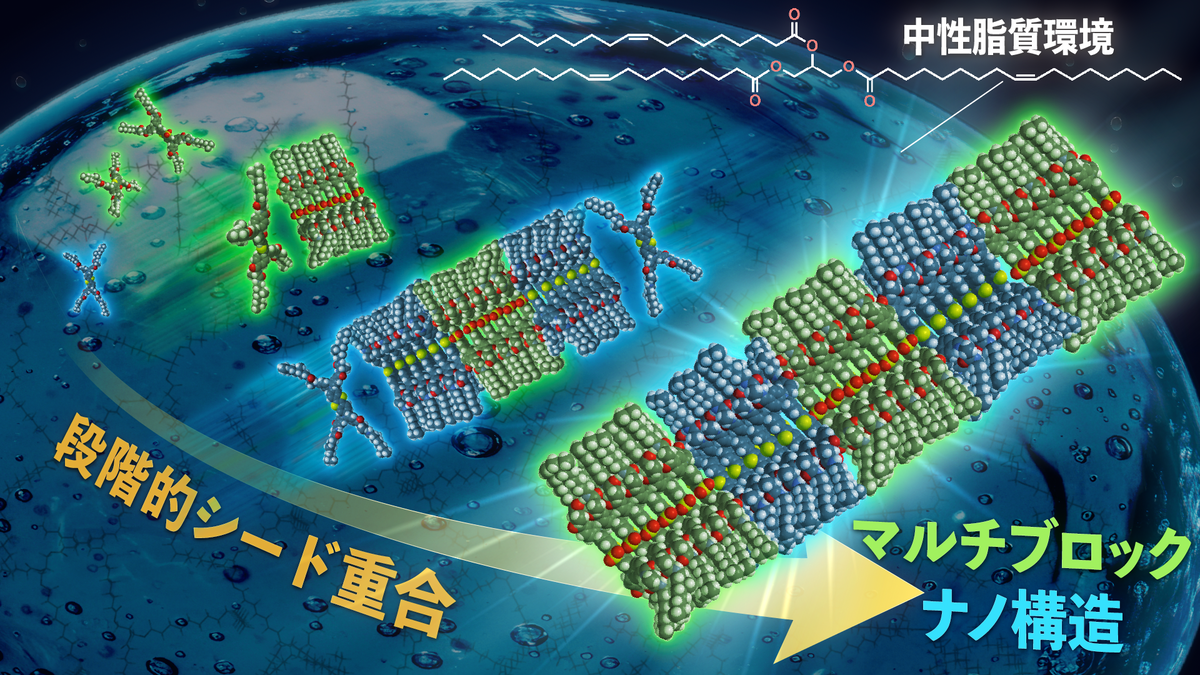
Supramolecular polymerization within living cells has emerged as a promising strategy for controlling cellular functions. Lipid droplets, intracellular organelles mainly composed of neutral lipids, provide low-polarity environments, yet their role in regulating supramolecular assembly pathways remains unclear. Here we show that triolein, a representative triacylglycerol featuring three ester groups and cis-9-octadecenyl chains, acts as an effective medium for kinetically controlled supramolecular polymerization. An alanine-based diamide-functionalized fluorophore forms supramolecular polymers in triolein through a nucleation-elongation mechanism, in which an initial nucleus triggers subsequent growth. Although the thermodynamic stability is comparable to that in di-n-butyl ether, a commonly used organic solvent, triolein suppresses spontaneous nucleation and inter-fiber bundling, creating a lag phase during which seeded polymerization guides monomers along a defined assembly pathway. Kinetic studies with ethyl oleate, a structural analogue of triolein, indicate that transient solute-solvent interactions contribute to the suppression of both nucleation and bundling events. This kinetic control enables stepwise seeded growth of multiblock nanostructures and establishes neutral lipids as functional media for the precision-controlled construction of supramolecular polymers.
