2026-07-08 京都大学
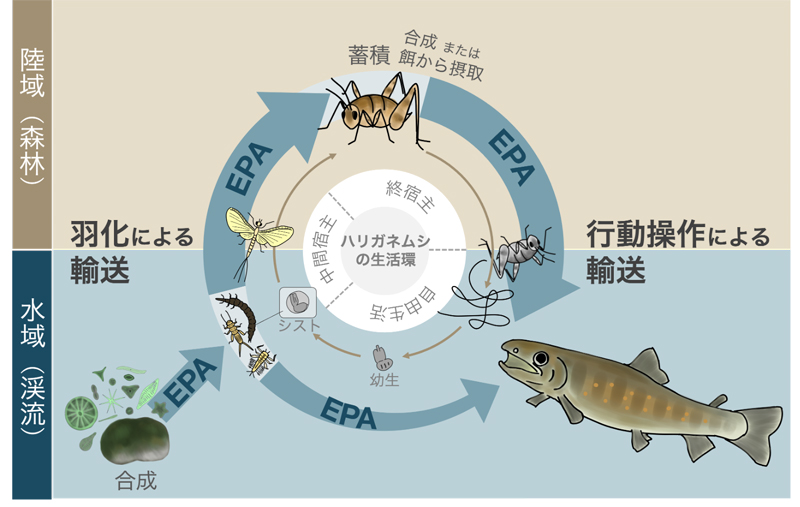
ハリガネムシに寄生・行動操作されたカマドウマによる陸域から水域へのEPAフローの概要。(イラスト:目戸綾乃)
<関連情報>
- https://www.kyoto-u.ac.jp/ja/research-news/2026-07-08-0
- https://www.kyoto-u.ac.jp/sites/default/files/2026-07/web-2607-Medo-91d9ccce170630d705795e5f94ac1374.pdf
- https://academic.oup.com/pnasnexus/article/5/7/pgag201/8724045
類線形虫ハリガネムシが駆動する陸域から水域への栄養素フロー Nematomorph parasites potentially drive nutritional flow from terrestrial to aquatic ecosystems
Ayano Medo ,Takuya Sato
PNAS Nexus Published:07 July 2026
DOI:https://doi.org/10.1093/pnasnexus/pgag201
Abstract
Long-chain polyunsaturated fatty acids (LC-PUFA), particularly eicosapentaenoic acid (EPA; 20:5n-3) are synthesized primarily by algae, such as diatoms and cryptophytes, in aquatic ecosystems. Although LC-PUFA flux has commonly been considered unidirectional from aquatic to terrestrial ecosystems, recent evidence suggests a potential reciprocal flow of EPA from terrestrial to aquatic systems via amphibious insects and terrestrial arthropods. Here, we report the possibility that nematomorph parasites drive the flow of EPA from terrestrial to aquatic ecosystems by inducing EPA-bearing terrestrial hosts to jump into streams. Individuals of camel crickets, a major host of the nematomorphs, had ∼4–17 times higher EPA mass than those of known aquatic invertebrates. An endangered charr population acquired more EPA from the camel crickets than from aquatic invertebrates in late summer through autumn, when the nematomorphs manipulated their hosts, in a temperate stream. Our results suggest that host manipulation by parasites potentially drives essential organic nutrient flow, with particular emphasis on the need to recognize reciprocal PUFA flow between terrestrial and aquatic ecosystems.