2026-07-15 東北大学
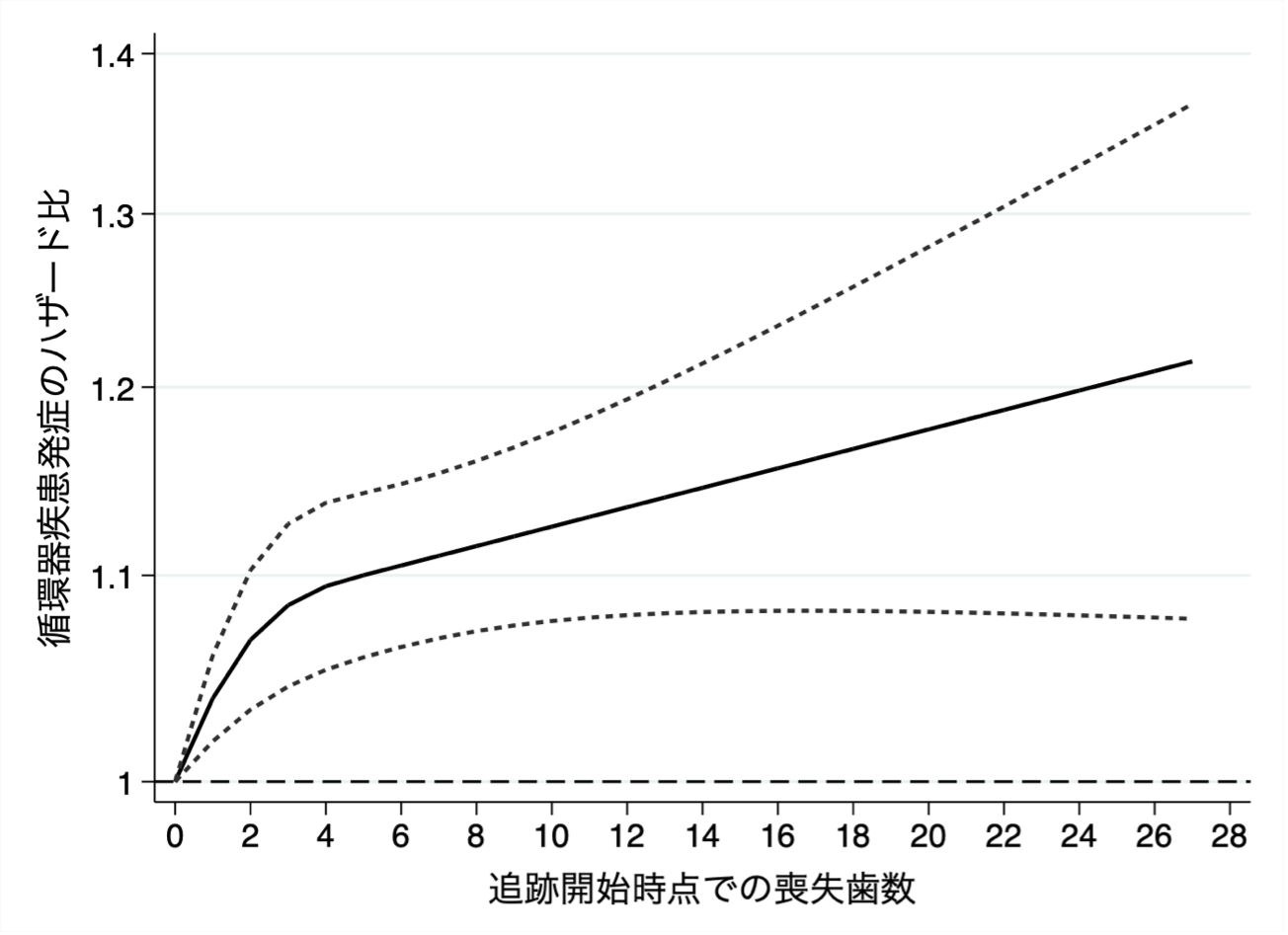
図1. 追跡開始時点の喪失歯数とその後の循環器疾患の発症リスクとの関連 (n = 551,386)
*補足:実線は推定値を、点線は信頼区間(真値が含まれると考えられる範囲)を示します。
<関連情報>
- https://www.tohoku.ac.jp/japanese/2026/07/press20260715-01-toothloss.html
- https://aap.onlinelibrary.wiley.com/doi/10.1002/jper.70167
中年成人における歯の喪失と心血管疾患との非線形な関連性 Non-linear association between tooth loss and cardiovascular diseases among middle-aged adults
Taro Kusama, Yudai Tamada, Takashi Miyano, Megumi Maeda, Futoshi Oda, Ken Osaka, Haruhisa Fukuda, Kenji Takeuchi
Journal of Periodontology Published: 12 July 2026
DOI:https://doi.org/10.1002/jper.70167
Abstract
Background
Although positive associations between fewer remaining teeth and an increased risk of various systemic diseases have been reported, the precise dose-response relationship has not been fully clarified. This study aimed to evaluate the non-linearity of the dose-response association between the number of lost teeth and the risk of cardiovascular diseases among middle-aged adults.
Methods
This retrospective cohort study, with over 5 years of follow-up, was based on medical claims and health check-up data. Participants were adults aged 40–64 in Japan. The outcome was the incidence of cardiovascular diseases. Exposure variables were the number of lost teeth, which was modeled using a restricted cubic spline. A Cox proportional hazards model was fitted to estimate hazard ratios (HRs) and 95% confidence intervals.
Results
Among the 551,386 participants (mean age = 50.0 years [SD = 6.7], male = 52.0%), the incidence rate of cardiovascular diseases was 0.70 per 100 person-years. A significant non-linear dose-response association was observed between the number of lost teeth and cardiovascular disease risk (p = 0.004). Although the risk increased with greater tooth loss, the dose-response curve bent at around four lost teeth, with an HR of 1.09 (1.05–1.14) at four teeth lost and 1.21 (1.08–1.37) at 27 teeth lost (reference: “no tooth loss”).
Conclusions
These findings suggest no clear threshold exists in the non-linear dose-response association between tooth loss and cardiovascular disease risk. Comprehensive public health strategies to prevent periodontal diseases and dental caries are essential throughout life to minimize tooth loss and its systemic consequences.
Plain language summary
This retrospective cohort study of 551,386 middle-aged adults found a significant non-linear dose-response association between tooth loss and the risk of cardiovascular diseases. Cardiovascular disease risk increased as the number of lost teeth increased; however, the dose-response curve showed an inflection at around four lost teeth, with no clear threshold observed in the association between tooth loss and cardiovascular disease risk.