2026-07-15 近畿大学
本研究の概要
<関連情報>
IL-17によって誘導されるがん細胞自身の炎症プログラムが、免疫療法の効きやすい微小環境をつくり出す IL-17–driven tumor cell–intrinsic inflammatory programming creates an immunotherapy-permissive microenvironment
Kosuke Murakami,Shiki Takamura,Chiho Miyagawa,Shiro Takamatsu,Yoko Kashima,Koji Nagaoka,Yukari Kobayashi,Yoshiyuki Hakata,Shigeki Kato,Sachiyo Tsuji-Kawahara,Ding Nan,Ronald Chandler,Satoru Takahashi,Masaaki Miyazawa,Kazuhiro Kakimi & Noriomi Matsumura Published:30 June 2026
DOI:https://doi.org/10.1186/s12943-026-02726-2
Abstract
Background
While immune checkpoint inhibitors (ICIs) have failed to improve outcomes in unselected ovarian cancer populations, objective responses are observed in a minority of ovarian clear cell carcinoma (OCCC) cases, implying biological heterogeneity and a yet-undefined immunologically responsive subset within this histotype.
Methods
We performed immunohistochemical profiling of tumor-infiltrating immune cells and analyzed transcriptomic data from human OCCC cohorts. Functional studies were conducted using an immunocompetent syngeneic OCCC mouse model to assess the effects of IL-17 on tumor cell inflammatory signaling, immune microenvironment remodeling, and responsiveness to immune checkpoint blockade, including single-cell RNA sequencing of tumor-infiltrating T cells.
Results
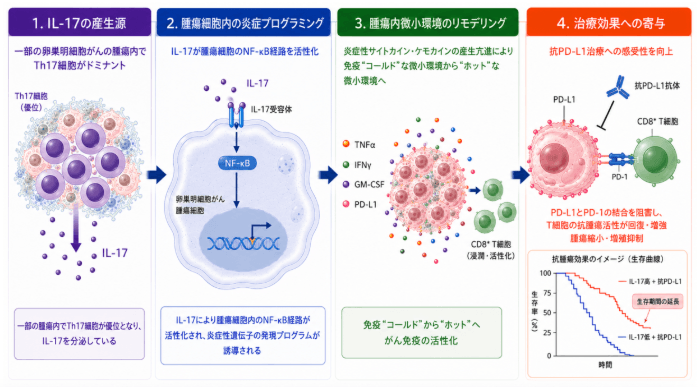
OCCC exhibited an immune-sparse tumor microenvironment with relative enrichment of CD4⁺ T cells. RORC expression was elevated in OCCC but showed intertumoral heterogeneity. In the transcriptome data (n = 180), an IL17Ahigh subset (5%), enriched within the RORChigh fraction, exhibited a T cell–inflamed gene expression profile independent of microsatellite instability and tumor mutational burden, yet was not associated with survival. Mechanistically, IL-17 directly activated NF-κB–dependent inflammatory programs in OCCC tumor cells, inducing cytokines and chemokines involved in T-cell recruitment and activation. In the syngeneic model, IL-17 exposure increased intratumoral CD4⁺ and CD8⁺ T-cell infiltration and activation. Single-cell profiling further revealed expansion of Th17/Tfh-like CD4⁺ T cells and cytotoxic, non-terminally exhausted CD8⁺ T cells. Consistent with these changes, anti–PD-L1 therapy improved survival in Th17-biased partial chimera mice.
Conclusions
IL-17–responsive, tumor cell–intrinsic inflammatory programming remodels the tumor immune microenvironment toward an immunotherapy-permissive state. These findings establish IL-17–responsive tumor cell inflammatory programming as a mechanistic axis shaping immune checkpoint sensitivity and provide a rationale for biomarker-guided immunotherapy strategies.