2026-07-27 北海道大学,理化学研究所,京都大学
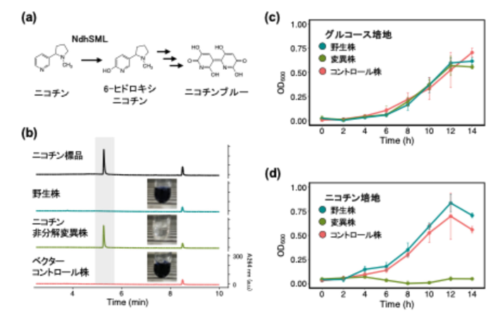
図1. (a)アルスロバクターによるニコチン分解経路。(b)ニコチン⾮分解変異株の作出。ニコチン分解遺伝⼦の⼀部を破壊することでニコチンを分解しない変異株が得られた。(c)グルコース及び(d)ニコチン培地におけるアルスロバクターの増殖。グルコース培地では野⽣株と変異株のどちらも増殖できるが、変異株はニコチン培地で増殖できない。
<関連情報>
- https://www.hokudai.ac.jp/news/2026/07/post-2377.html
- https://www.hokudai.ac.jp/news/pdf/260727_pr3.pdf
- https://link.springer.com/article/10.1186/s40168-026-02466-x
ニコチン異化遺伝子クラスターの水平伝達は、タバコ根の微生物叢におけるArthrobacterの適応度を高める Horizontal acquisition of nicotine catabolism gene cluster enhances Arthrobacter fitness within tobacco root microbiota
Tomohisa Shimasaki,Yui Nose,Sachiko Masuda,Arisa Shibata,Tsubasa Shoji,Shuhei Yabe,Maiko Furubayashi,Yoshitomo Kikuchi,Ken Shirasu,Kazufumi Yazaki,Yasunori Ichihashi,Akifumi Sugiyama & Ryohei Thomas Nakano
Microbiome Published:15 July 2026
DOI:https://doi.org/10.1186/s40168-026-02466-x Unedited version
Abstract
Background
Plant roots are hotspots for interactions with soil microbes, where a characteristic bacterial community structure is formed. Plant specialized metabolites often play pivotal roles in this assembly process. However, the molecular basis underlying root microbiota responses to these bioactive compounds, and how such metabolic interactions shape the assembly of host-specific root microbiota, remain largely unknown. Nicotine is a toxic alkaloid predominantly produced by the genus Nicotiana, and the genus Arthrobacter is known as one of the nicotine-degrading bacteria in the tobacco root microbiota. In this study, we used the tobacco–Arthrobacter interaction system as a model and integrated comparative genomics and experimental genetic manipulation assays to uncover the role of bacterial catabolism capacity for host specialized metabolites in shaping host-specific root microbiota.
Results
Nicotine catabolism genes are uniquely found in the Arthrobacter strains derived from nicotine-containing environments, and this restricted gene distribution is driven by a plasmid-mediated horizontal gene transfer. To assess the ecological consequences of this genomic adaptation in Arthrobacter fitness in tobacco roots, we characterized the nicotine utilization ability of Arthrobacter and conducted adaptation assays under in planta conditions using genetically manipulated Arthrobacter strains and tobacco mutants impaired in nicotine catabolism and biosynthesis, respectively. Nicotine improves Arthrobacter colonization of tobacco roots through a catabolism-dependent mechanism. Bacterial community analysis using a synthetic community approach further demonstrated that this metabolic adaptation enhances Arthrobacter fitness within tobacco root microbiota.
Conclusions
Our findings illustrated that bacterial catabolic capacity toward host-derived plant specialized metabolites is key for successful root colonization. This metabolic adaptation is driven by plasmid-mediated horizontal gene transfer and ultimately shapes the structure of the root microbiota community.