
2026-08-06 バージニア工科大学(Virginia Tech)
<関連情報>
- https://news.vt.edu/articles/2026/08/science-b12.html
- https://academic.oup.com/ismej/article/20/1/wrag160/8714114
バクテリオファージによる細胞溶解は、代謝的に有用な栄養素を細胞外に放出し、細菌群集を広範囲に調節する Bacteriophage-mediated cell lysis externalizes a metabolically valuable nutrient to broadly modulate bacterial communities
David da Silva Barreira,Hannah M Poole,Rogério A Bataglioli,Bryan B Hsu
The ISME Journal Published:23 June 2026
DOI:https://doi.org/10.1093/ismejo/wrag160
Abstract
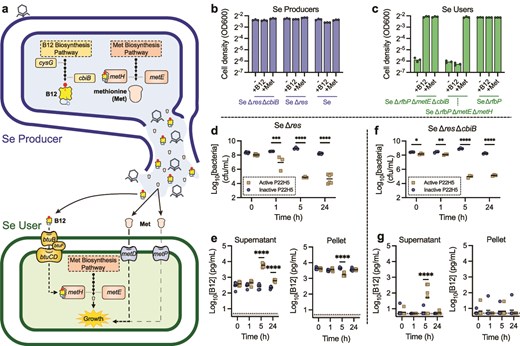
Cobamides, including vitamin B12, are essential cofactors exchanged between organisms across diverse ecosystems including oceans, soils, and the mammalian gut. Although most organisms depend on cobamides, only a minority of prokaryotes perform their metabolically costly biosynthesis. This has led to vitamin B12 uptake from the environment as a common acquisition strategy, but does not explain why B12 producers would allow B12 to become extracellularly available. Our work reconciles this inconsistency, showing that bacteriophages (phages) can facilitate the release of intracellular B12 at physiologically relevant concentrations. Phages are viruses that infect and often lyse their targeted bacteria, which may externalize intracellular material along with progeny phages. In this work, we aimed to determine whether phage-mediated lysis promotes the externalization of vitamin B12, thereby supporting the growth of B12-dependent bacteria. To test this, we first used genetically well-defined B12-Producer and B12-User bacteria, and found that phage-mediated lysis of the producers releases sufficient B12 to support the growth of the users in co-culture. Next, we showed that phage-mediated lysis of the B12-producer can similarly support the growth of various commensal gut bacteria that are also B12-dependent, in co-culture. B12 released by phage-mediated cell lysis induced significant compositional changes among the non-targeted bacteria including an increased diversity that was muted by supplementing B12 in the medium. Collectively, these findings suggest that phage-mediated bacterial lysis is a significant contributor to nutrient externalization in microbial communities, leading to broad compositional changes beyond their host range.

