2026-08-10 国立遺伝学研究所
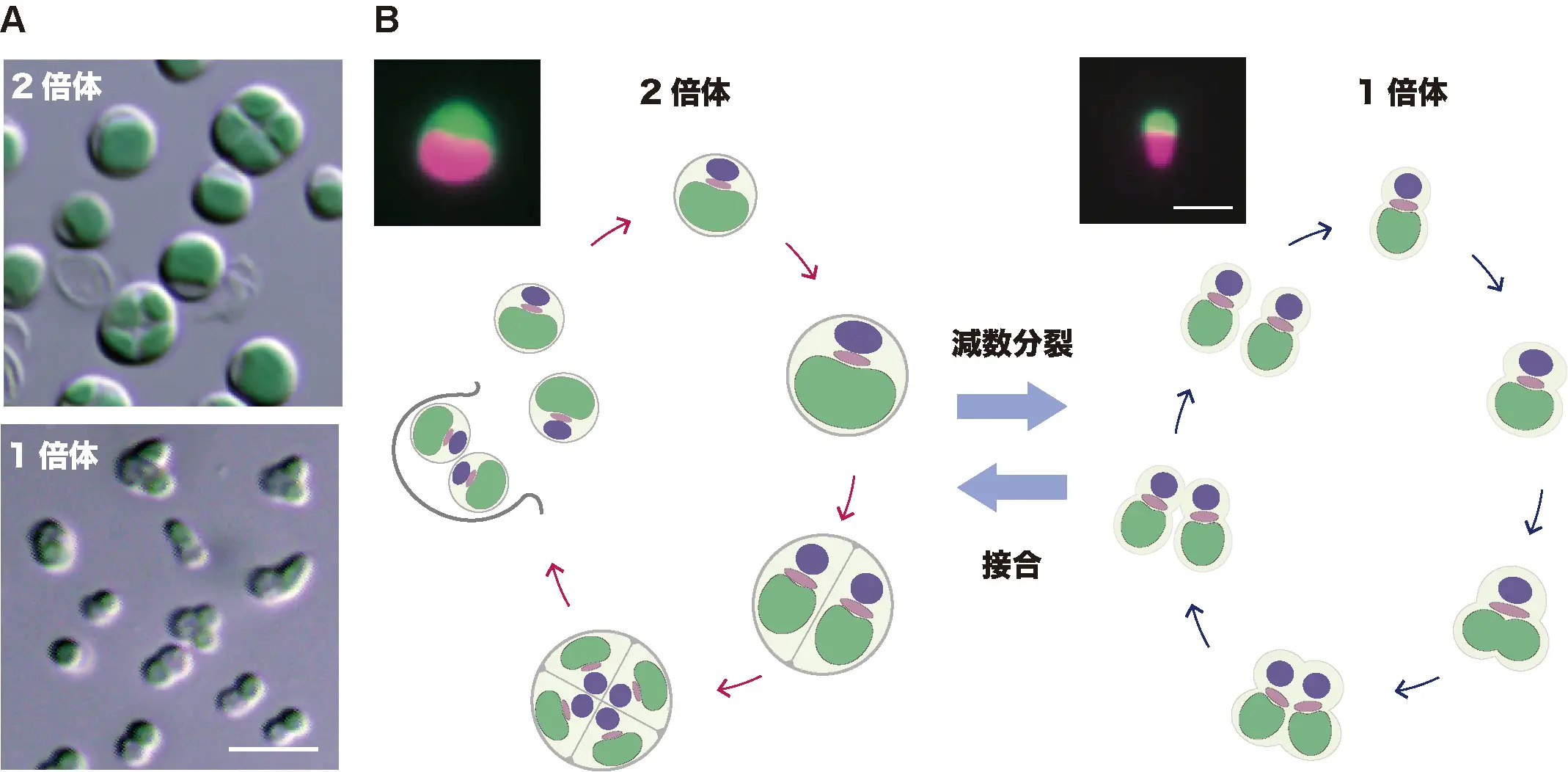
イデユコゴメ綱で明らかになった有性生殖サイクル。
<関連情報>
- https://www.nig.ac.jp/highlights/14611/
- https://academic.oup.com/plcell/article/38/7/koag148/8702969?login=false
有性生殖サイクルにより、単細胞紅藻類シアニディオ藻類は真核生物の進化を遺伝学的に解析しやすいモデル生物として確立される Sexual life cycle establishes the unicellular red algae Cyanidiophyceae as a genetically tractable model for eukaryotic evolution
Shunsuke Hirooka,Takayuki Fujiwara,Mark Seger,Soichi Inagaki,Shota Yamashita,Dai Tsujino,Ryo Onuma,Yu Kanesaki,Satoru Watanabe,Yuu Hirose,…
The Plant Cell Published:05 June 2026
DOI:https://doi.org/10.1093/plcell/koag148
Abstract
The thermo-acidophilic unicellular algal class Cyanidiophyceae diverged from other red algae soon after primary chloroplast acquisition. Cyanidiophyceae possess extremely simple genomes (8.7 to 17.8 Mb; approximately 4,800 to 7,800 genes), and the cell wall-less, genetically tractable strain Cyanidioschyzon merolae 10D has served as a model organism. However, its unknown sexual life cycle has limited its utility in studies of evolution and genetics. Here, we show that in the genera Cyanidioschyzon, Cyanidiococcus, and Cyanidium, the cell-walled diploid form, exclusively observed in nature, produces a cell wall-less haploid form when the culture pH is lowered, and both proliferate asexually. Cz. merolae 10D is a haploid clone that forms a cell-walled diploid through mating with other haploid clones. In addition, we generated high-quality genomic resources with phase-specific transcriptomes, identified a compact candidate mating-type region, and developed genetic manipulation systems using the cell wall-less haploids of these genera. We further uncovered phase-specific distributions of histone H3 lysine 27 trimethylation linked to haploid- and diploid-specific gene expression, including transcription factors involved in differentiation associated with sexual reproduction in plants. Additionally, biparental inheritance of organelle DNA occurs following isogamous mating of haploid cells but resolves into uniparental inheritance during diploid proliferation. These advances position Cyanidiophyceae as a powerful model lineage for studying early Archaeplastida evolution, the shared mechanisms of photosynthetic eukaryotes, and environmental adaptation.