2026-08-19 北海道大学
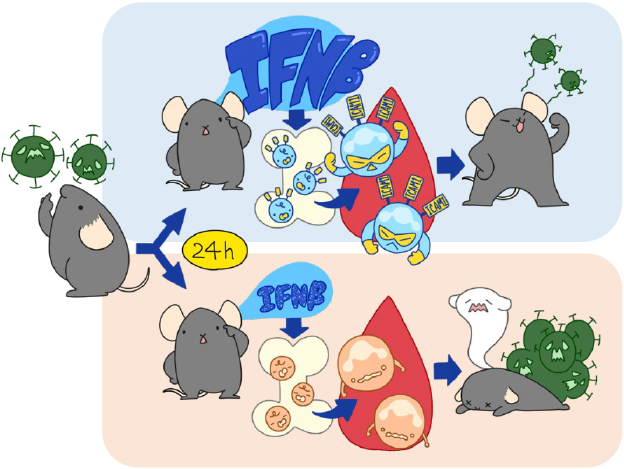
本研究の概要図
<関連情報>
- https://www.hokudai.ac.jp/news/2026/08/24-9.html
- https://www.cell.com/iscience/fulltext/S2589-0042(26)02567-8
I型インターフェロンが誘導するICAM1陽性好中球が、致死性ウイルス感染における生存を左右する Type I IFN dynamics orchestrate protective ICAM1+ neutrophil heterogeneity as an early checkpoint for survival in lethal viral infection
Riho Saito ∙ Yuan Ding ∙ Kureha Satou ∙ … ∙ Hideki Ukai ∙ Yukiko Gotoh ∙ Tomohiko Okazaki
iScience Published:August 18, 2026
DOI:https://doi.org/10.1016/j.isci.2026.117189
Highlights
- Early systemic IFN responses determine survival after VSV infection
- Survival-associated IFN surge correlates with ICAM1+ neutrophil polarization
- ICAM1+ neutrophils exhibit pro-inflammatory and enhanced phagocytic features
- Neutrophil-specific ICAM1 deletion impairs antiviral host protection
Summary
The early host response influences outcomes following viral infection. Here, we leveraged variability in survival after intranasal vesicular stomatitis virus (VSV) challenge in genetically identical mice to retrospectively profile systemic immune responses associated with survival or lethality. Survival was strongly associated with a robust systemic type I interferon (IFN) surge within 24 h of infection, and blockade of type I IFN signaling during this narrow early window markedly reduced survival, establishing early IFN induction as a key determinant of outcome. This protective IFN surge rapidly remodeled the systemic immune landscape, inducing a specialized ICAM1+ neutrophil subset, primed within the bone marrow and characterized by a pro-inflammatory signature and enhanced phagocytic activity. Importantly, neutrophil-specific deletion of ICAM1 significantly reduced survival following viral infection. Together, these findings identify an early type I IFN-dependent checkpoint that shapes protective ICAM1+ neutrophil heterogeneity and disease trajectories, with implications for prognostic strategies and host-directed therapies.