2026-09-07 京都大学
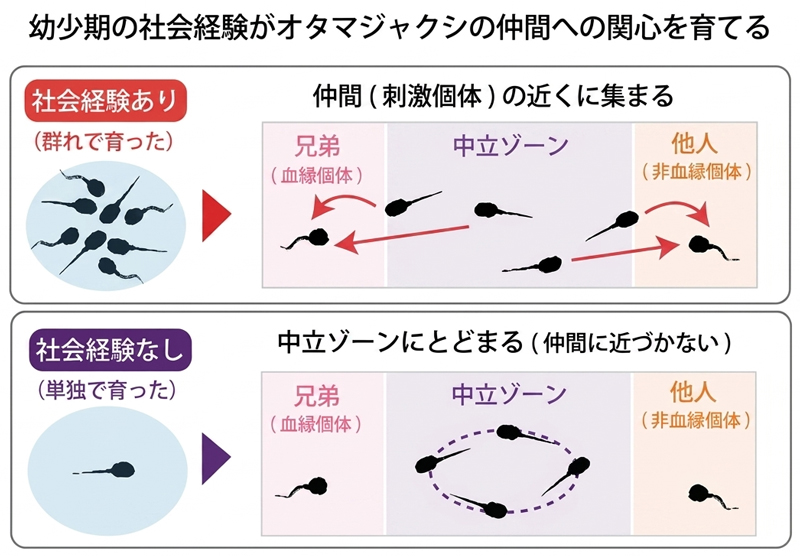
兄弟同士で育てた「集団飼育」と単独で育てた「単独飼育」のグループを用意し、同種他個体に対する社会的選好性の選択テストを行った。(作成・撮影:長谷和子)
<関連情報>
- https://www.kyoto-u.ac.jp/ja/research-news/2026-09-07-0
- https://link.springer.com/article/10.1007/s10071-026-02090-0
アズマヒキガエルの幼生は血縁よりも社会経験によって集合性を左右される Social isolation, rather than kinship, influences association behavior in toad tadpoles (Bufo formosus)
Kazuko Hase
Animal Cognition Published:06 August 2026
DOI:https://doi.org/10.1007/s10071-026-02090-0
Abstract
Experiences of social isolation alter the developing social behavior of animals. Association preference is an important behavioral tendency for amphibian larvae (tadpoles) that exhibit social aggregation as a means of predator avoidance. For tadpoles that exhibit social aggregation, the learning period during exposure to conspecifics could be crucial. This study investigated how water quality and social experience influence association preferences to unfamiliar conspecifics in Bufo formosus (Eastern-Japanese common toad) tadpoles. Using a 2 × 2 factorial design, subject tadpoles were reared either in tap or pond water and under group or solitary conditions. Binary-choice tests were then conducted to examine whether the tadpoles preferred siblings, non-siblings, or neither (neutral zone). No significant kin-biased association was detected in any treatment. However, social experience significantly affected the proportion of time spent in neutral zone. Solitary-raised tadpoles spent the most time in the neutral zone, whereas group-raised tadpoles spent more time on the effective-stimulus sides irrespective of water quality. It suggests that social isolation in early developmental stage reduces responsiveness to conspecifics. These findings indicate that social aggregation in B. formosus is shaped by social experience rather than kinship and aquatic environment.