2026-10-06 スタンフォード大学
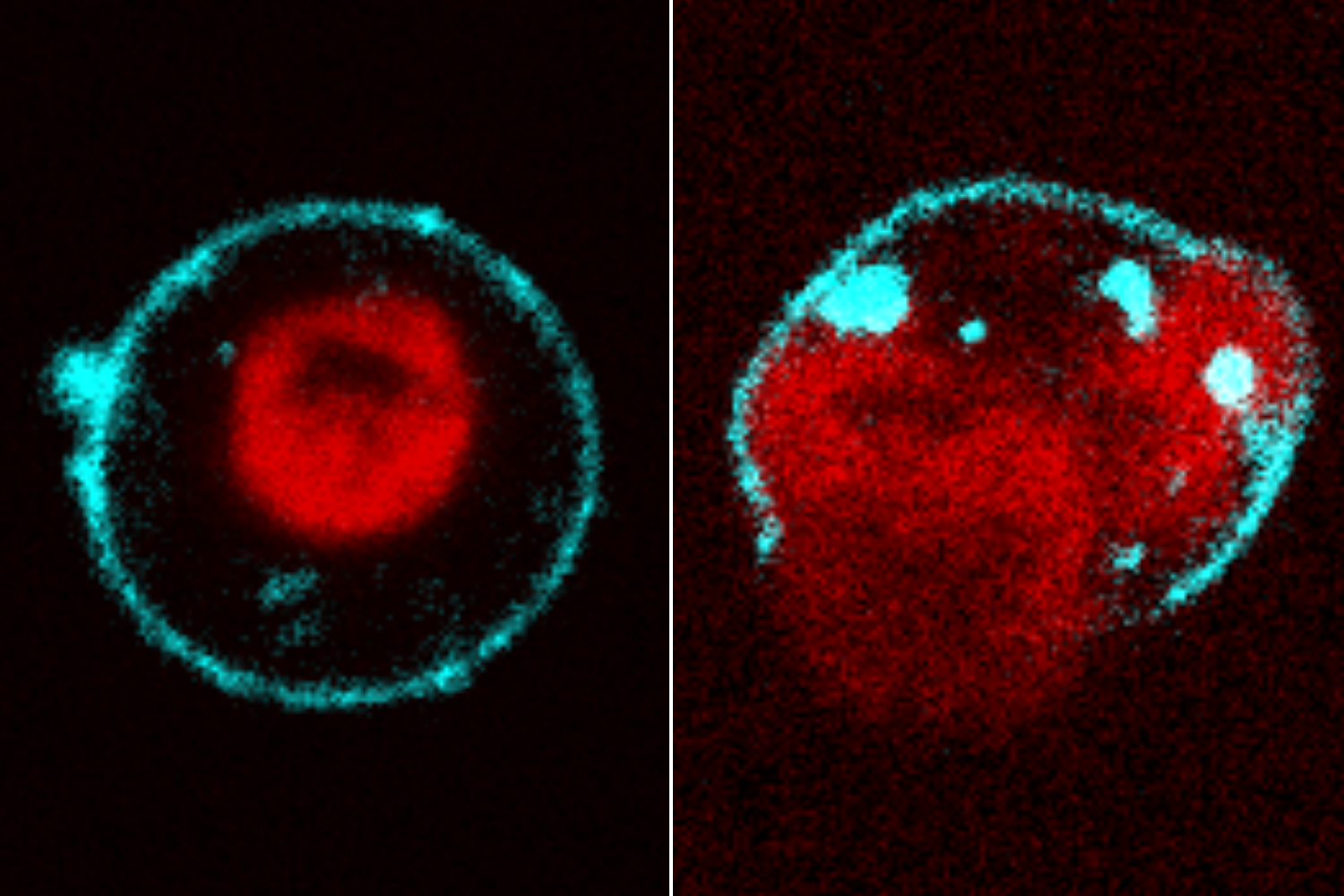
Certain immune cells go through NETosis, an extreme process in which they swell up until the cell membrane (cyan) breaks and the cell pops like an overfilled balloon. DNA, normally stored tightly wound as chromatin (magenta) in the nucleus (left), becomes less compacted, breaks out of the nucleus, and spills out of the cell (right) to trap pathogens. | Aidan Cabral
<関連情報>
- https://news.stanford.edu/stories/2026/10/immune-cell-pop-autoimmune-diseases
- https://www.nature.com/articles/s41467-026-76578-1
核内のクロマチン脱凝縮は、転写とは無関係に、細胞膜の張力を増加させ、NETosisの実行を促進する Chromatin decompaction within the nucleus increases plasma membrane tension promoting NETosis execution, independently of transcription
Aidan T. Cabral, Manasi Sawant, Minwoo Kang, Liangqi Xie & Hawa Racine Thiam
Nature Communications Published:20 August 2026
DOI:https://doi.org/10.1038/s41467-026-76578-1
Abstract
Chromatin organizes DNA and regulates nuclear mechanics. However, whether and how chromatin regulates whole-cell mechanics and functions independently of transcription is largely unknown. Here, leveraging transcription-independent NETosis, we show that chromatin decompaction within the nucleus increases plasma membrane tension and cell volume. Mechanistically, we show that chromatin accessibility gradually increases and chromatin binding proteins (CBPs) H1, HP1α, and H3 differentially dissociate from chromatin as it decompacts during NETosis. We posit that dissociated CBPs become osmolytes that alter cellular osmolarity. Consistently, tuning extracellular osmolarity or disrupting regulators of membrane tension and cell volume (mTORC1/2, NHEs, or VRAC ion channels) alters plasma membrane rupture and NETosis execution. In non-NETing U2OS cells, decompacting chromatin increases membrane tension, independently of the cytoskeleton, indicating a causal relationship between chromatin organization and membrane tension. This work shows chromatin as a regulator of whole-cell mechanics, broadening our understanding of the non-genetic roles of chromatin in cell pathophysiology.