2026-10-22 京都大学
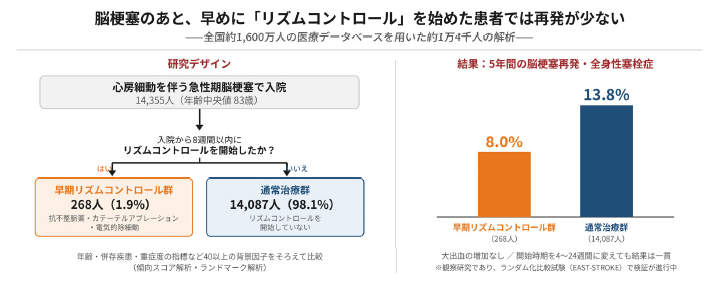
心房細動を伴う脳梗塞患者約1万4千人を、脳梗塞後8週間以内にリズムコントロールを開始した群と通常治療群に分けて比較した。早期リズムコントロール群では5年間の再発率が8.0%と、通常治療群(13.8%)より低かった。©️京都大学/江頭柊平
<関連情報>
- https://www.kyoto-u.ac.jp/ja/research-news/2026-10-22-0
- https://www.neurology.org/doi/10.1212/WNL.0000000000218736
心房細動を伴う急性期脳梗塞後の早期リズムコントロールと通常治療の比較 Early Rhythm Control vs Usual Care After Acute Ischemic Stroke in Patients With Atrial Fibrillation
Shuhei Egashira, Kosuke Inoue, Masatoshi Koga, Kazunori Toyoda, Märit Jensen, Götz Thomalla, Tatsushi Toda, and Yuichi Imanaka
Neurology Published:October 21, 2026
DOI:https://doi.org/10.1212/WNL.0000000000218736
Abstract
Background and Objectives
Early rhythm control reduces cardiovascular events in patients with atrial fibrillation (AF); however, its effectiveness in the setting of acute ischemic stroke remains uncertain. We aimed to examine whether early rhythm control after acute ischemic stroke is associated with a lower risk of recurrent stroke or systemic embolism (SE) in patients with AF.
Methods
This nationwide cohort study used the DeSC-IQVIA integrated database, an administrative claims database covering approximately 16 million individuals in Japan. Adults hospitalized for acute ischemic stroke with AF present at admission between 2014 and 2025 were included. The exposure was initiation of rhythm control (antiarrhythmic drugs, catheter ablation, or electrical cardioversion) within 8 weeks of admission (early rhythm control) vs no initiation (usual care), assessed at a landmark. The primary outcome was hospitalization for recurrent ischemic stroke or SE. Secondary outcomes included major bleeding, heart failure (HF) hospitalization, and all-cause mortality. Baseline differences were adjusted using propensity score overlap weighting. Cause-specific hazard ratios (HRs), cumulative incidence with death as a competing risk, and risk differences at 5 years were estimated.
Results
Among 14,355 patients who survived event-free through the 8-week landmark (median age, 83 years [IQR, 78–88]; 6,935 [48.3%] women), 268 (1.9%) received early rhythm control. During 23,583 person-years, early rhythm control was associated with a lower risk of stroke/SE (HR, 0.56; 95% CI 0.32–0.97; weighted 5-year cumulative incidence, 8.0% vs 13.8%; risk difference, −5.9 percentage points [95% CI −11.0 to 0.8]). Among secondary outcomes, no association was observed with major bleeding (HR, 1.44; 95% CI 0.74–2.82) or HF hospitalization (HR, 0.73; 95% CI 0.39–1.38); early rhythm control was associated with lower all-cause mortality (HR, 0.72; 95% CI 0.53–0.97). Results were consistent across landmark periods of 4–24 weeks.
Discussion
In this nationwide cohort study, early rhythm control after acute ischemic stroke in patients with AF was associated with a reduced risk of recurrent stroke or SE. These findings suggest that early rhythm control may serve as an additional secondary prevention strategy for ischemic stroke, with flexible timing of initiation. These observational findings are hypothesis-generating and warrant confirmation in randomized controlled trials.