2026-11-06 マウントサイナイ医療システム(MSHS)
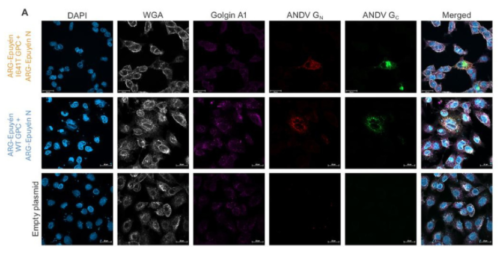
Microscopy images show the cell membrane, Golgi apparatus, and differences in the cellular localization of Andes virus glycoproteins between ARG-Epuyén wild-type and I641T variants. Credit: Science Advances and Natalia Ferressini Gerpe/Icahn School of Medicine at Mount Sinai
<関連情報>
- https://www.mountsinai.org/about/newsroom/2026/mount-sinai-study-identifies-single-amino-acid-change-that-alters-andes-virus-protein-behavior-in-human-cells
- https://www.science.org/doi/10.1126/sciadv.aek2522
げっ歯類とヒトのアンデスウイルスにおける単一アミノ酸の違いがウイルス糖タンパク質の輸送に影響を与える A single–amino acid difference between rodent and human Andes virus affects viral glycoprotein trafficking
Santiago Vidal-Freire, Natalia M. Ferressini-Gerpe, Carla M. Bellomo, André Filipe Pastor, Maya Tagliavia, Rachel Somavarapu, Shruti Shirsathe, Jayden Zhang, Elaina Giannetti, […] , and Gustavo Palacios
Science Advances Published:6 Nov 2026
DOI:https://doi.org/10.1126/sciadv.aek2522
Abstract
Andes virus (ANDV) causes hantavirus pulmonary syndrome (HPS), with rare outbreaks involving person-to-person transmission. A human ANDV isolate from one such outbreak and a rodent isolate from the same region differ in lethality in Syrian golden hamsters. Genomic analysis revealed 25 nonsynonymous substitutions, including one leading to a T641I change in the human ANDV glycoprotein precursor near its cleavage site. Although the isolates differed in growth kinetics, strand-specific RT-qPCR did not support major differences in viral RNA synthesis, whereas virion release was delayed in the case of the human isolate. In human cell expression systems, a single I641T substitution in the human ANDV glycoprotein resulted in decreased Golgi retention and faster release of virion-like particles relative to wild-type glycoprotein. Since ANDV egress takes place at the Golgi, the T641I change present in the human ANDV isolate may represent a human adaptive mutation influencing glycoprotein trafficking and virus particle release.