2026-11-11 ロックフェラー大学
ロックフェラー大学の研究チームは、腸管内に多く存在する抗体「免疫グロブリンA(IgA)」が、大腸上皮細胞の過剰な増殖を抑え、大腸がんの発生を防ぐ仕組みを明らかにした。マウスを用いた実験では、IgAを欠損した個体は正常な個体に比べて大腸腫瘍が2倍以上多く発生し、IgAを経口投与すると腫瘍増加のリスクが抑制された。研究チームは、腸内細菌に応答して上皮細胞の増殖を促す受容体DMBT1にIgAが結合し、その増殖シグナルにブレーキをかけることを発見した。この作用は特定の細菌に対する抗体の結合特異性ではなく、IgA分子の構造に由来することも示された。本成果は、腸内細菌、粘膜免疫、腸管上皮細胞の相互作用が大腸がんの発生に関わることを示すものであり、将来的には大腸がんの予防や再発リスク低減に向けた新たな介入法の開発につながる可能性がある。ただし、現段階ではマウスを中心とした基礎研究であり、ヒトでの予防効果は今後の検証が必要である。
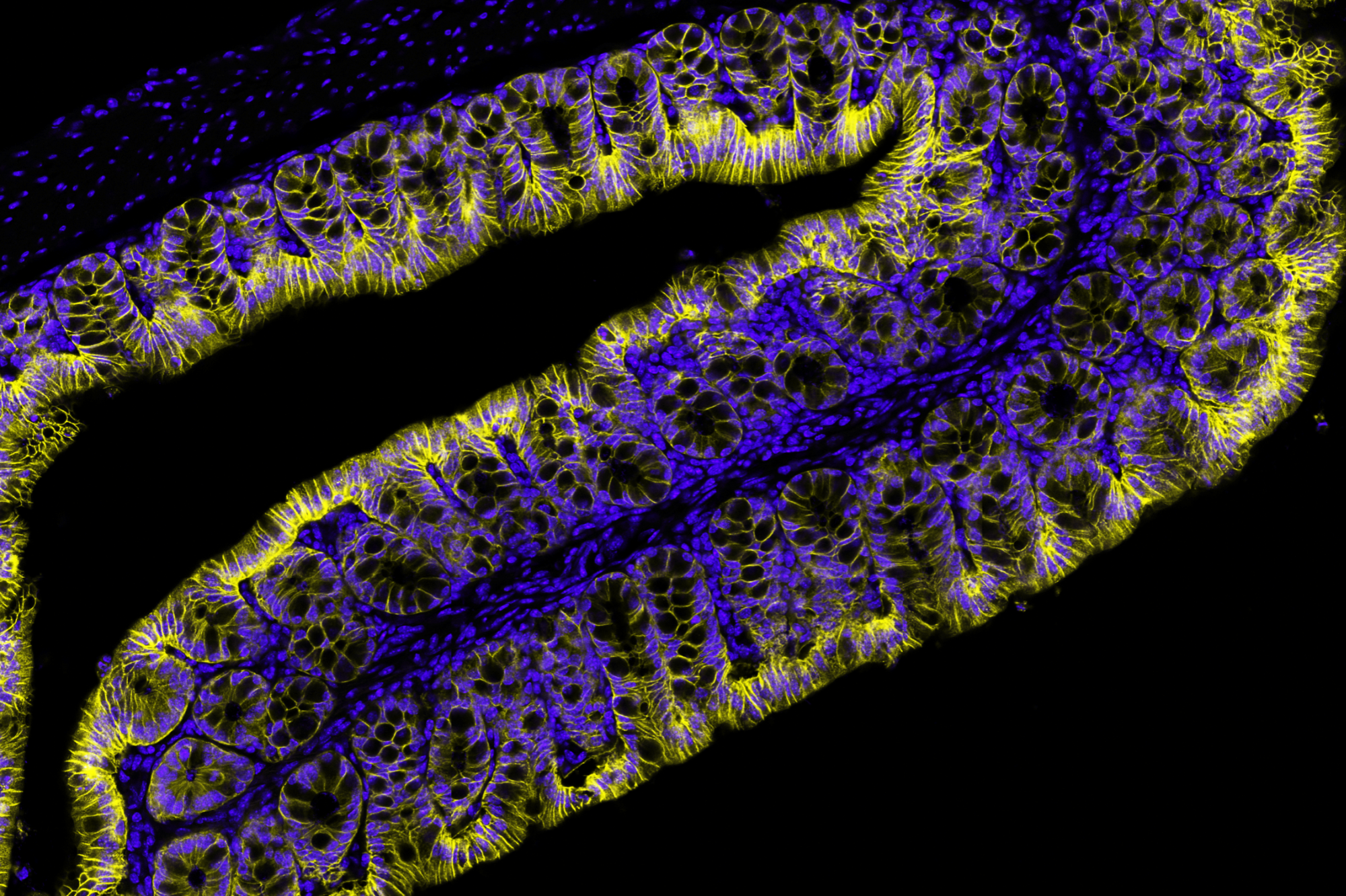
Confocal microscopy image of a proximal colon fold (mouse), showing EPCAM for epithelial cells (yellow) and DAPI-stained nuclei (violet). (Credit: Vitoria Murakami Olyntho)
<関連情報>
- https://www.rockefeller.edu/news/40877-colon-cancer-gut-tumor-antibody-intestine/
- https://www.nature.com/articles/s41586-026-11264-2
IgAによる上皮細胞増殖および腫瘍形成の抑制 Suppression of epithelial proliferation and tumorigenesis by IgA
Gregory P. Donaldson, Gabriella Lima dos Reis, Marwa Saad, Christopher Wichmann, Izabela Mamede, Guo Chen, Caroline E. Harrer, Nicole L. DelGaudio, Dayu Zhang, Begüm Aydin, Tiago B. R. Castro, Sergei I. Grivennikov, Bernardo S. Reis, Elise G. Liu, Stephanie C. Eisenbarth, Kivanç Birsoy, Sohail F. Tavazoie, Beth M. Stadtmueller, Gabriel D. Victora & Daniel Mucida
Nature Published:11 November 2026
DOI:https://doi.org/10.1038/s41586-026-11264-2
Tii-summary
免疫グロブリンA(IgA)は、腸管粘膜で常時分泌され、常在微生物の定着や機能を調節する主要な抗体であるが、腸管上皮の恒常性維持における役割は十分に解明されていなかった。本研究では、遺伝的・環境的条件を制御した複数のIgA欠損マウスモデルを用い、IgAの欠如が大腸上皮細胞の増殖亢進と大腸がん発症感受性の上昇を引き起こすことを明らかにした。IgAが存在しない場合、腸内細菌叢に応答して大腸上皮細胞の抗菌因子産生が増加し、細胞周期が加速した。一方、IgAを経口投与すると、上皮細胞の生理的な増殖が抑制され、腫瘍形成も減少した。この作用は抗体の抗原結合特異性ではなく、IgAの構造そのものに依存していた。さらに、IgAは上皮細胞表面タンパク質DMBT1に結合し、これを介して細胞増殖を直接抑制することが判明した。IgA欠損マウスでは、DMBT1の膜貫通領域および細胞内シグナル領域を欠失させることで、上皮細胞の増殖亢進と腫瘍感受性の上昇がともに改善した。本成果は、IgAとDMBT1が腸内細菌叢に対する上皮細胞の過剰な応答を抑え、腸管粘膜の恒常性と大腸がん抑制に寄与する新たな仕組みを明らかにした。
Immunoglobulin A (IgA) is the predominant antibody isotype at mucosal surfaces, where it regulates the colonization and function of commensal microorganisms. However, its role in maintaining intestinal epithelial homeostasis has remained unclear. Using genetically and environmentally controlled mouse models, this study demonstrates that IgA deficiency increases susceptibility to several forms of endogenous colorectal cancer. In the absence of IgA, colonic epithelial cells respond to the microbiota by increasing antibacterial factor production and accelerating cell-cycle progression. Conversely, oral administration of IgA suppresses steady-state epithelial proliferation and protects mice against tumour development. This protective effect depends on the structural properties of IgA rather than its antigen-binding specificity. Mechanistic investigations identified DMBT1, an epithelial surface protein, as an IgA-binding partner required for the suppression of epithelial proliferation. IgA directly inhibited epithelial growth through DMBT1, while deletion of the transmembrane and cytoplasmic signalling regions of DMBT1 reversed the increased epithelial proliferation and tumour susceptibility observed in IgA-deficient mice. These findings establish an important homeostatic function for IgA and reveal an IgA–DMBT1 signalling mechanism that restrains excessive epithelial responses to the gut microbiota, thereby maintaining intestinal mucosal health and limiting colorectal tumorigenesis.
Immunoglobulin A (IgA) is the predominant antibody isotype at mucosal surfaces, where it regulates the colonization and function of commensal microorganisms. However, its role in maintaining intestinal epithelial homeostasis has remained unclear. Using genetically and environmentally controlled mouse models, this study demonstrates that IgA deficiency increases susceptibility to several forms of endogenous colorectal cancer. In the absence of IgA, colonic epithelial cells respond to the microbiota by increasing antibacterial factor production and accelerating cell-cycle progression. Conversely, oral administration of IgA suppresses steady-state epithelial proliferation and protects mice against tumour development. This protective effect depends on the structural properties of IgA rather than its antigen-binding specificity. Mechanistic investigations identified DMBT1, an epithelial surface protein, as an IgA-binding partner required for the suppression of epithelial proliferation. IgA directly inhibited epithelial growth through DMBT1, while deletion of the transmembrane and cytoplasmic signalling regions of DMBT1 reversed the increased epithelial proliferation and tumour susceptibility observed in IgA-deficient mice. These findings establish an important homeostatic function for IgA and reveal an IgA–DMBT1 signalling mechanism that restrains excessive epithelial responses to the gut microbiota, thereby maintaining intestinal mucosal health and limiting colorectal tumorigenesis.
出典:Nature (2026)。出版社掲載のAbstractに基づく要約。