
2026-10-14 国立がん研究センター,京都大学,名古屋大学
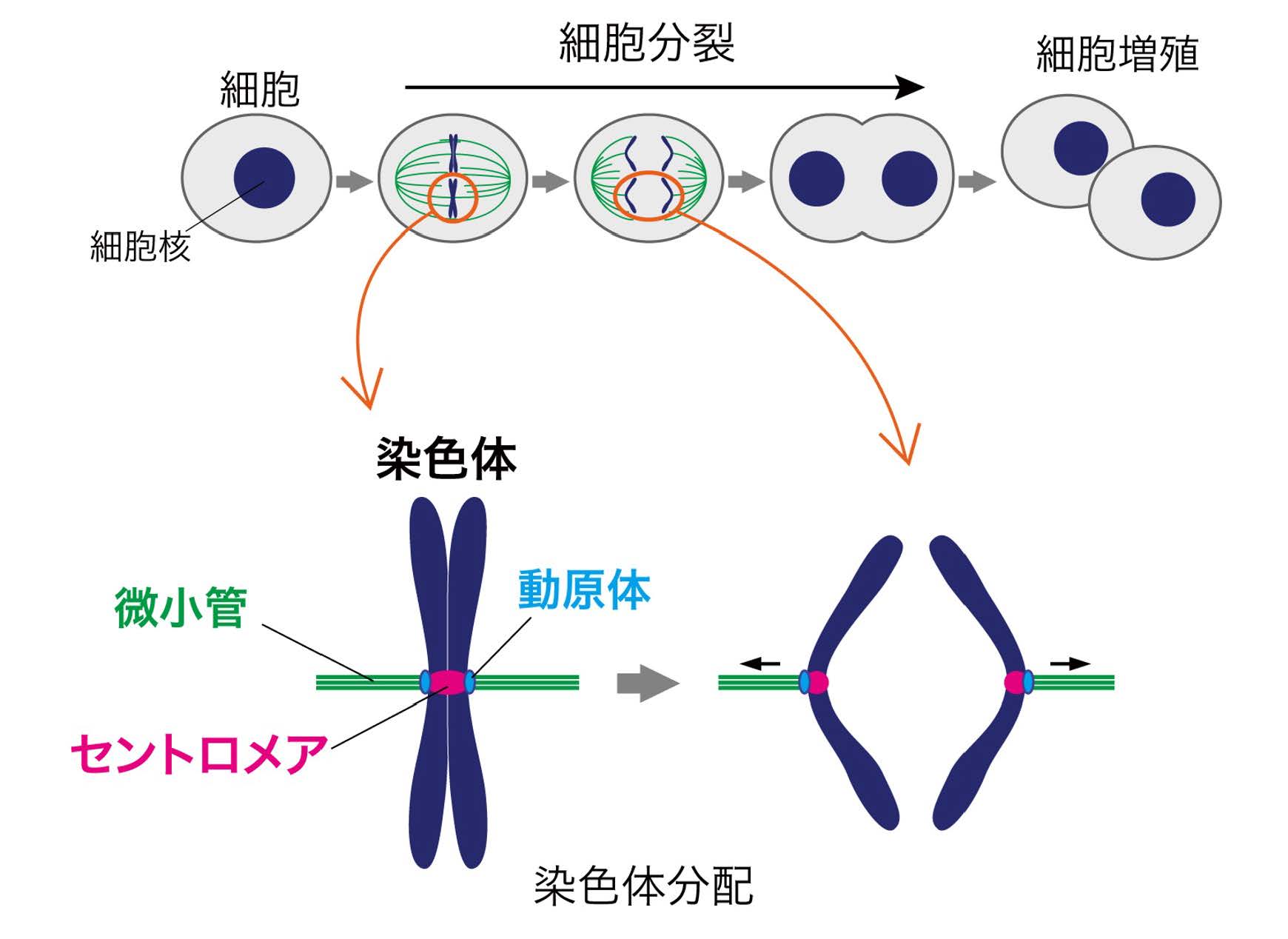
図1 セントロメアの位置と役割
出典:大阪大学 深川竜郎研究室ウェブサイト(一部改変)
<関連情報>
- https://www.ncc.go.jp/jp/information/pr_release/2026/1014/index.html
- https://www.cell.com/cell/fulltext/S0092-8674(26)01064-0
希少なk-mer配列は、ヒトの多様性と癌の転座の根底にあるセントロメアハプログループを明らかにする Rare k-mers reveal centromere haplogroups underlying human diversity and cancer translocations
Yuichi Shiraishi ∙ Yotaro Ochi, ∙ Masahiro Sugawa ∙ … ∙ Erik Garrison ∙ Glennis A. Logsdon ∙ Seishi Ogawa
Cell Published:October 13, 2026
DOI:https://doi.org/10.1016/j.cell.2026.08.053
Highlights
- Rare k-mer markers enable efficient classification of human centromere haplotypes
- ascairn accurately infers centromere haplotypes and haplogroups from short reads
- Human populations harbor diverse centromere haplogroups with geographic structure
- Centromere haplogroups modulate susceptibility to 1p/19q co-deletion in brain tumors
Summary
Human centromeres are highly variable but remain among the least characterized regions of the genome because their repetitive structure has hindered conventional analysis of population diversity and disease relevance. Here, we show that rare k-mers in centromeric regions capture lineage-specific variation, defining discrete haplogroups with distinct structural features. We developed ascairn to infer these haplogroups from short-read whole-genome sequencing (WGS) data. Applying this framework to >3,300 genomes reveals extensive global diversity in centromere haplogroups and signatures of population history. Analyzing short-read WGS data from 142 oligodendroglioma cases with 1p/19q co-deletion, we mapped breakpoints to the centromere regions of chromosomes 1 and 19, revealing a clear positional relationship to kinetochore attachment sites and a link between centromere haplotype structure and rearrangement susceptibility. Rare k-mers thus open centromeres to population-scale analysis, linking centromere structural diversity to human evolutionary history and disease-associated genomic instability.

