2026-11-17 中国科学院(CAS)
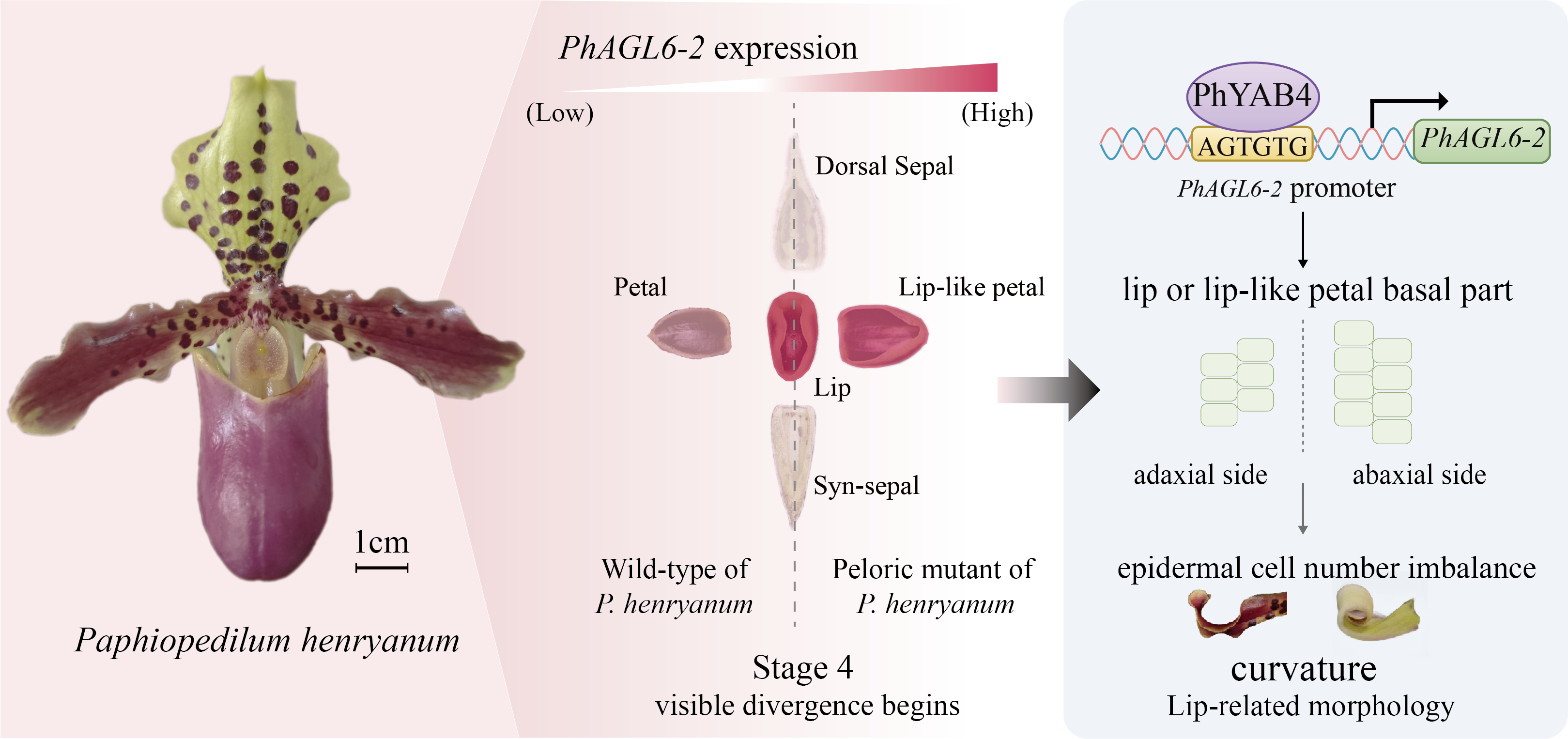
Schematic model illustrating the role of the PhYAB4–PhAGL6-2 transcriptional regulatory module in lip-related floral organ curvature morphogenesis in Paphiopedilum henryanum. (Image by FANG Lin)
<関連情報>
- https://english.cas.cn/newsroom/research-news/202611/t20261117_1219698.shtml
- https://nph.onlinelibrary.wiley.com/doi/10.1111/nph.71706
PhYAB4がPhAGL6-2を直接活性化し、パフィオペディルムの唇弁に関連する花器官の湾曲形態を制御する
PhYAB4 directly activates PhAGL6-2 to regulate lip-related organ curvature morphology in Paphiopedilum henryanum
Yuying Yin, Yan Li, Jingjue Zeng, Lin Li, Kunlin Wu, Xiaomei Deng, Huacai Zhuang, Chao Feng, Ming Kang, Songjun Zeng, Lin Fang. New Phytologist, published online 6 November 2026. Early View
DOI: https://doi.org/10.1111/nph.71706
ラン科植物パフィオペディルムの花に特徴的な唇弁や花弁の湾曲が形成される分子機構を明らかにした。研究チームは、Paphiopedilum henryanumの通常型とType Aペロリック変異体を比較し、花の発達段階4から花器官の形態に違いが現れることを確認した。湾曲には、花器官の先端部における向軸側と背軸側の表皮細胞数の不均衡が関係していた。遺伝子発現解析では、唇弁で高発現するPhAGL6-2を特定し、YABBY転写因子PhYAB4がそのプロモーターに直接結合して転写を活性化することを明らかにした。PhYAB4またはPhAGL6-2の発現をウイルス誘導性遺伝子サイレンシングによって抑制すると、花被片の湾曲などの形態変化が生じた。これらの結果から、PhYAB4–PhAGL6-2の遺伝子制御経路が、表皮細胞数の偏りを通じて花器官の湾曲や形態形成に関与することが示された。本研究は、ラン科植物に特徴的な花の形態形成を理解するための分子基盤を提供する。
This study investigates the molecular mechanisms underlying lip-related organ curvature in the orchid Paphiopedilum henryanum. By comparing wild-type flowers with Type A peloric mutants, the researchers found that visible differences in floral organ morphology emerge from developmental Stage 4. Curvature was associated with an imbalance in epidermal cell numbers between the adaxial and abaxial sides of the distal organ region, rather than substantial differences in average cell area. Transcriptome and expression analyses identified PhAGL6-2, an AGL6-like gene preferentially expressed in lips and lip-like petals. The YABBY transcription factor PhYAB4 was shown to bind directly to the AGTGTG motif in the PhAGL6-2 promoter and activate its transcription. Virus-induced gene silencing of either gene affected floral organ curvature, while PhYAB4 silencing also caused lip outgrowths and partial disruption of floral symmetry. These findings identify a PhYAB4–PhAGL6-2 regulatory pathway involved in epidermal cell number asymmetry and floral organ morphogenesis, providing insights into the molecular basis of specialized orchid flower development.