2026-11-18 スウェーデン王立工科大学(KTH)
スウェーデン王立工科大学(KTH)と製薬企業AstraZenecaの研究チームは、細胞内でタンパク質や細胞小器官を分解・再利用するオートファジーの開始に関わる遺伝子 ULK1 をノックアウトすることで、医薬品開発に用いる膜タンパク質の生産量を増やす手法を開発した。ヒト由来の研究用細胞株でULK1を不活性化したところ、創薬標的として重要な膜タンパク質GIPR、GPR75、P2X3の生産量が、それぞれ約30%、80%、100%増加した。
膜タンパク質は承認済み医薬品の約60%が標的とする重要な分子群だが、構造や性質のため大量生産が難しい。従来は細胞のタンパク質生産能力を高める方法が主に検討されてきたのに対し、本研究は細胞内の分解・再利用経路を抑えるという逆のアプローチを採用した。遺伝子改変後も細胞に明確な悪影響は認められず、転写産物量の増加も確認された。創薬研究に必要な標的タンパク質の供給効率を高め、医薬品開発の迅速化や研究開発コストの低減につながる可能性がある。
<関連情報>
- https://www.kth.se/en/om/nyheter/centrala-nyheter/disabling-cells-clean-up-crew-could-speed-drug-target-production-1.1509159
- https://www.cell.com/cell-systems/fulltext/S2405-4712(26)00261-9
ULK1のノックアウトは組換え転写産物の量を増加させ、組換え膜タンパク質の発現を改善する(ULK1 knockout increases recombinant transcript abundance and improves recombinant membrane protein expression)
Alice Karlsson, Melanie Dannemeyer, Jenny Gunnarsson, Niklas Berndt Thalén, Jennifer Hicks, Magnus Lundqvist, Anna Backmark, Susanna Engberg, Carina Raynoschek, Anna-Luisa Volk, Ramy Elgendy, Michael J. Munson, Magdalena Malm, Robert G. Roth, Johan Rockberg
Cell Systems, Volume 17, Article 101779(Online ahead of print)2026-11-12PubMed
DOI:10.1016/j.cels.2026.101779

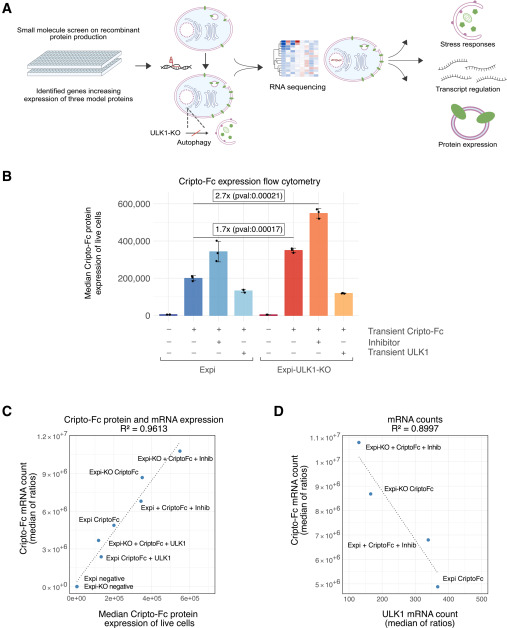
Figure 1 Overview of gene identification via small-molecule screening and effect of ULK1 KO on mRNA expression levels and recombinant protein expression levels.Karlsson, A. et al. (2026). ULK1 knockout increases recombinant transcript abundance and improves recombinant membrane protein expression. Cell Systems. https://doi.org/10.1016/j.cels.2026.101779
Licensed under CC BY 4.0.
膜タンパク質は医薬品の重要な標的である一方、研究や創薬に必要な量を細胞で生産することが難しい。本研究では、細胞内のオートファジーを開始するキナーゼULK1に着目し、ヒト由来Expi293細胞でULK1遺伝子をノックアウトした生産細胞株を作製した。その結果、分泌型モデルタンパク質の発現量は最大1.7倍に増加し、3種類のモデル膜タンパク質では最大2倍に達した。特に可溶性画分で増加が顕著であり、個別の膜タンパク質ではGIPR、GPR75、P2X3の生産量がそれぞれ約30%、80%、100%増加した。トランスクリプトーム解析では、オートファジー関連遺伝子群の発現低下に加え、組換えタンパク質の転写産物量の増加、膜構成やタンパク質局在に関わる過程の変化、細胞ストレス応答の低下が示された。これらの結果は、細胞内のタンパク質分解・再利用経路を調節することが、組換えタンパク質生産性を高める新たな細胞工学的手法となる可能性を示す。特に、生産が難しい膜タンパク質の構造・機能解析や創薬研究に必要な試料の確保への応用が期待される。ただし、効果は検証された細胞株とモデルタンパク質に基づくものであり、他のタンパク質や大規模製造工程への適用性は今後の検証課題である。
Membrane proteins are important drug targets, but producing sufficient quantities for research and drug discovery remains challenging. This study focused on ULK1, a kinase that initiates cellular autophagy, and generated a ULK1-knockout human Expi293 cell line. The knockout increased the expression of a secreted model protein by up to 1.7-fold and the production of three model membrane proteins by up to twofold, with particularly pronounced increases in the soluble fraction. Production of the individual membrane proteins GIPR, GPR75, and P2X3 increased by approximately 30%, 80%, and 100%, respectively. Transcriptomic analyses revealed downregulation of autophagy-associated genes, increased recombinant transcript abundance, changes in processes related to membrane organization and protein localization, and weaker cellular stress responses. These findings indicate that modifying intracellular protein degradation and recycling pathways may provide a new strategy for improving recombinant protein production. The approach could be particularly useful for generating materials required for structural and functional studies of difficult-to-produce membrane proteins and for drug discovery. However, the results were obtained using a specific cell line and a limited set of model proteins, and further studies are needed to establish its applicability to other proteins and large-scale manufacturing processes.