この多様性の一因は、生息地の照明の違いにあることが判明。 Scientists discover that this diversity is partly due to lighting differences in their habitats
2022-10-15 シンガポール国立大学(NUS)
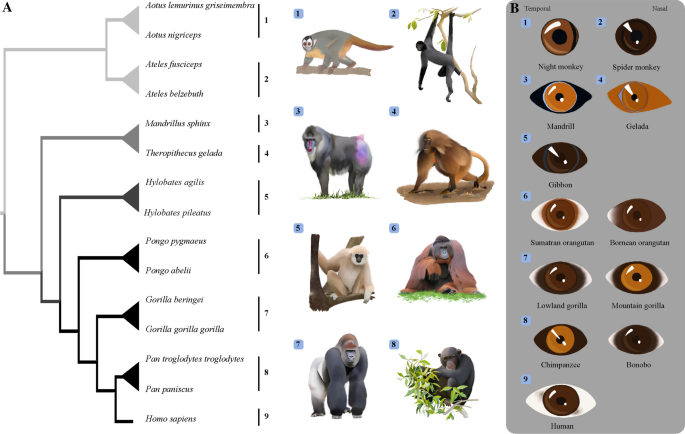
研究チームは、77種の霊長類から数百枚の写真を収集し、目のさまざまな部分の明るさと色を測定した。その結果、赤道から遠い場所に生息する種は、結膜(虹彩を包む組織)が薄くなる傾向があり、人間の皮膚の色素沈着と似ていることがわかった。また、虹彩の色も、褐色になりやすい赤道から遠い個体ほど、緑色や青色になるように変化している。
目の色の違いは、霊長類の自然な範囲に典型的に見られる照明の変化によって説明できることから、虹彩の色は、皮膚の色素沈着と同様に、人間の環境条件によって選択された可能性があることが示唆された。
<関連情報>
- https://news.nus.edu.sg/nus-study-addresses-the-causes-of-eye-colour-variation-in-primates/
- https://www.nature.com/articles/s41598-022-20900-6
霊長類における目の形と色調の変化には、生態的な要因が関与している可能性が高い Ecological factors are likely drivers of eye shape and colour pattern variations across anthropoid primates
Juan Olvido Perea-García,Kokulanantha Ramarajan,Mariska E. Kret,Catherine Hobaiter & Antónia Monteiro
Scientific Reports Published:15 October 2022
DOI:https://doi.org/10.1038/s41598-022-20900-6
Abstract
External eye appearance across primate species is diverse in shape and colouration, yet we still lack an explanation for the drivers of such diversity. Here we quantify substantial interspecific variation in eye shape and colouration across 77 primate species representing all extant genera of anthropoid primates. We reassess a series of hypotheses aiming to explain ocular variation in horizontal elongation and in colouration across species. Heavier body weight and terrestrial locomotion are associated with elongated eye outlines. Species living closer to the equator present more pigmented conjunctivae, suggesting photoprotective functions. Irises become bluer in species living further away from the equator, adding to existing literature supporting a circadian clock function for bluer irises. These results shift the current focus from communicative, to ecological factors in driving variation in external eye appearance in anthropoid primates. They also highlight the possibility that similar ecological factors contributed to selection for blue eyes in ancestral human populations living in northern latitudes.