2026-02-20 東北大学
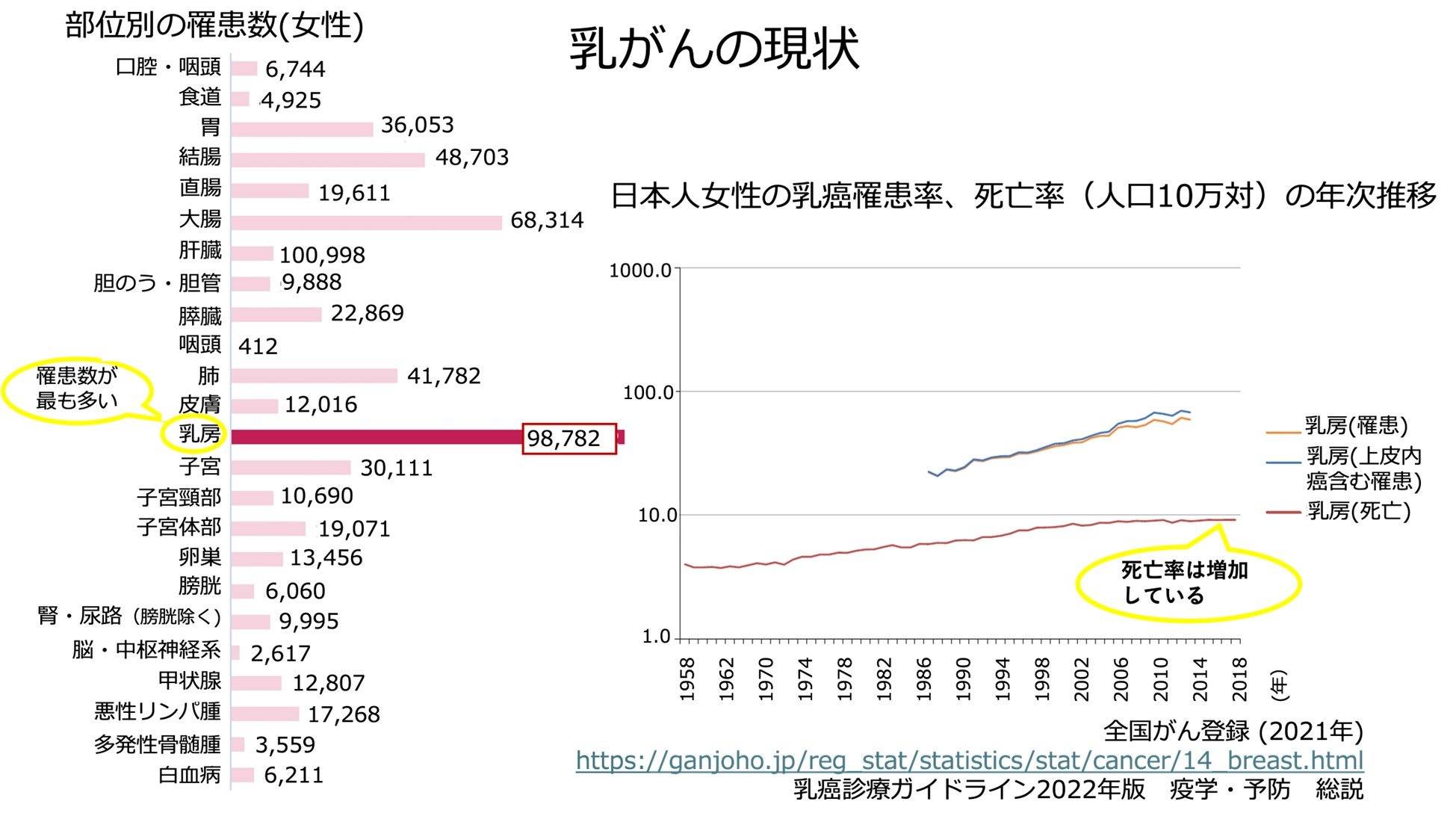
図1.乳がんの罹患数と死亡率の推移
2021年の統計では女性のがん罹患の中で最も多く、死亡率は増加傾向にあります。
<関連情報>
- https://www.tohoku.ac.jp/japanese/2026/02/press20260220-02-cancer.html
- https://www.tohoku.ac.jp/japanese/newimg/pressimg/tohokuuniv-press20260220_web02_cancer.pdf
- https://www.thelancet.com/journals/lancet/article/PIIS0140-6736(25)02319-0/abstract
補助的超音波検査に関する日本戦略的抗がんランダム化試験(J-START)における40~49歳の女性における進行乳がんの累積発生率:事前に規定された二次解析 Cumulative incidence of advanced breast cancer in women aged 40–49 years in the Japan Strategic Anti-cancer Randomised Trial (J-START) of adjunctive ultrasonography: a prespecified secondary analysis
Narumi Harada-Shoji, MD PhD ∙ Prof Akihiko Suzuki, MD PhD ∙ Prof Takanori Ishida, MD PhD ∙ Prof Seiichiro Yamamoto, PhD ∙ Seiki Kanemura, MD PhD ∙ Prof Takuhiro Yamaguchi, PhD ∙ et al.
The Lancet Published: February 21, 2026
DOI:https://doi.org/10.1016/S0140-6736(25)02319-0
Summary
Background
The J-START randomised controlled trial found that adjunctive ultrasonography was associated with significantly higher rates of breast cancer detection than mammography alone. This report aims to evaluate the long-term effect of adjunctive ultrasonography screening on the cumulative incidence of advanced breast cancer as a prespecified secondary outcome of J-START.
Methods
We enrolled asymptomatic women in 42 study sites in 23 of 47 prefectures in Japan. Eligible women were aged 40–49 years without a history of breast cancer, including in-situ cancer, or other cancers in the previous 5 years, and who had a life expectancy of more than 5 years. Participants were assigned in a 1:1 ratio to undergo ultrasonography with mammography (intervention group) or mammography alone (control group) twice during a 2-year screening period by individual or cluster randomisation. Participants attended an initial screening appointment and were then asked to return for a second screening after 2 years. This prespecified secondary analysis assessed the cumulative incidence of stage 2 or higher breast cancers based on the TNM classification up to data cutoff on Oct 4, 2024.
Findings
Between Aug 2, 2007, and March 31, 2011, 72 661 asymptomatic women aged 40–49 years were randomly assigned (36 723 in the intervention group and 35 938 in the control group). Median follow-up for this secondary analysis was 11·4 years (range 0·0–16·1; IQR 9·3–12·9) in the intervention group and 11·3 years (0·0–16·1; 8·9–12·9) in the control group. Of 894 breast cancers detected in the intervention group, 234 (26%) were advanced cancers, compared with 277 (33%) of 843 detected breast cancers in the control group (hazard ratio 0·83 [95·6% CI 0·70–0·98]; p=0·026). Kaplan–Meier curves suggested a violation of the proportional hazards assumption, with a significant difference in advanced cancer incidence only between 48 months and 96 months. Divergence between groups emerged around year four, widened until year eight, and remained stable thereafter.
Interpretation
Adjunctive ultrasonography reduced the cumulative incidence of advanced breast cancer in women aged 40–49 years. These findings highlight the potential value of integrating adjunctive ultrasonography into screening programmes for women with dense breast tissue, particularly in Asian populations, and could inform future breast cancer screening guidelines.
Funding
The Ministry of Health, Labor, and Welfare (Japan) and Japan Agency for Medical Research and Development.