2026-03-05 沖縄科学技術大学院大学(OIST)
<関連情報>
- https://www.oist.jp/ja/news-center/news/2026/3/5/reconstructing-worlds-ant-diversity-3d
- https://www.nature.com/articles/s41592-026-03005-0
- https://www.science.org/doi/10.1126/sciadv.adx8068
- https://www.cell.com/cell/fulltext/S0092-8674(25)00617-8
- https://medibio.tiisys.com/100489/
世界のアリの生物多様性に関するハイスループットフェノミクス High-throughput phenomics of global ant biodiversity
Julian Katzke,Francisco Hita Garcia,Philipp D. Lösel,Fumika Azuma,Tomáš Faragó,Lazzat Aibekova,Alexandre Casadei-Ferreira,Shubham Gautam,Adrian Richter,Evropi Toulkeridou,Sabine Bremer,Elias Hamann,Jenny Hein,Janes Odar,Chandan Sarkar,Marcus Zuber,Jacobus J. Boomsma,Rodrigo M. Feitosa,Lukas Schrader,Guojie Zhang,Sándor Csősz,Minsoo Dong,Olivia Evangelista,Georg Fischer,The Antscan GAGA Consortium,… Thomas van de Kamp
Nature Methos Published:05 March 2026
DOI:https://doi.org/10.1038/s41592-026-03005-0
Abstract
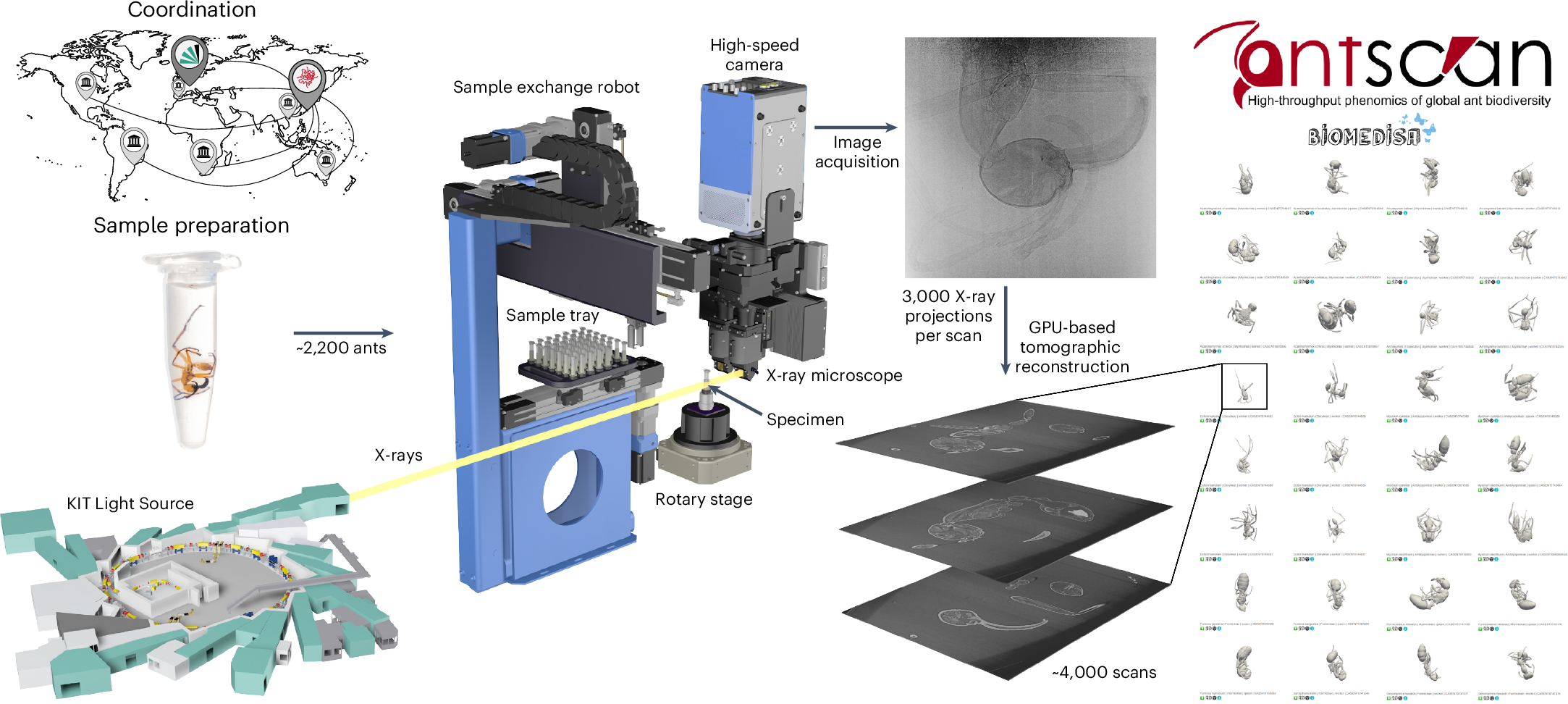
The big data era in biology is underway, but the study of organismal form has been slow to capitalize on advances in imaging and computation. Imaging approaches can digitize whole organisms, but low throughput has limited the effort to document morphological diversity. Here, within the open science initiative ‘Antscan’, we applied high-throughput synchrotron X-ray microtomography to capture phenotypes across a diverse and ecologically dominant insect group: ants. At https://www.antscan.info, we provide 2,193 whole-body three-dimensional ant datasets from 212 genera and 792 species to broadly cover the ant phylogeny with a global scope, also pairing phenomic data with genome sequencing projects. Scans acquired with standardized parameters facilitate automated analysis, and free access to data can broaden the audience and incentivize methods development. Antscan presents a scalable approach to create libraries of diverse anatomies, heralding an era of studies on the evolution, structure and function of organismal phenotypes.
より安価な働きアリの進化は、より大きな社会を促進し、アリの多様化を加速させた The evolution of cheaper workers facilitated larger societies and accelerated diversification in ants
Arthur Matte, Benoit Guénard, Shubham Gautam, Fumika Azuma, […] , and Evan P. Economo
Science Advances Published:19 Dec 2025
DOI:https://doi.org/10.1126/sciadv.adx8068
Abstract
Trade-offs between quantity and quality are common in the organization and evolution of biological, technological, and economic systems. In social insects, shifts from solitary organisms to complex societies bring this dilemma to the colony scale: producing fewer robust units or many cheaper ones. We investigate how cuticle investment, a major nutritional cost, shaped the evolution of ant societies and diversification. Using a computer vision approach on three-dimensional x-ray microtomography scans of 880 specimens from 507 species, we show that larger colonies were facilitated by reducing exoskeleton investment rather than miniaturizing workers. Reduced cuticle investment was associated with accelerated diversification rates in ants, whereas other candidates—colony size and worker size—did not correlate with diversification. Diet and climate had measurable but secondary effects on cuticle investment. Our results support a hypothesis whereby evolving cheaper but more numerous units through reduced investment in structural tissues was a strategic trend in the evolution and diversification of complex insect societies.
アリの適応放散と社会進化 Adaptive radiation and social evolution of the ants
Joel Vizueta ∙ Zijun Xiong ∙ Guo Ding ∙ … ∙ Lukas Schrader ∙ Jacobus J. Boomsma ∙ Guojie Zhang
Cell Published:June 16, 2025
DOI:https://doi.org/10.1016/j.cell.2025.05.030
Highlights
- Comparative analyses of 163 genomes uncover major adaptive changes in ant evolution
- Caste-associated genes maintained synteny despite high rates of macrosynteny loss
- Juvenile hormone, insulin, and MAPK pathways regulate queen-worker caste differentiation
- Co-evolving social traits left coherent signatures of selection on overlapping gene sets
Summary
Ants originated over 150 million years ago through an irreversible transition to superorganismal colony life. Comparative analyses of 163 ant genomes, including newly generated whole-genome sequences of 145 ant species, reveal extensive genome rearrangements correlated with speciation rates. Meanwhile, conserved syntenic blocks are enriched with co-expressed genes involved in basal metabolism and caste differentiation. Gene families related to digestion, endocrine signaling, cuticular hydrocarbon synthesis, and chemoreception expanded in the ant ancestor, while many caste-associated genes underwent positive selection in the formicoid ancestor. Elaborations and reductions of queen-worker dimorphism and other social traits left convergent signatures of intensified or relaxed selection in conserved signaling and metabolic pathways, suggesting that a core gene set was used to diversify organizational complexity. Previously uncharacterized genetic regulators of caste development were confirmed by functional experiments. This study reconstructs the genetic underpinning of social traits and their integration within gene-regulatory networks shaping caste phenotypes.