2026-014-17 中国科学院(CAS)
<関連情報>
- https://english.cas.cn/newsroom/research-news/202604/t20260417_1157488.shtml
- https://link.springer.com/article/10.1186/s43897-025-00212-9
アグライア・オドラタの高精度ゲノムアセンブリにより、センダン科植物の進化、テルペンの多様性、および豊富さが明らかになった High-quality genome assembly of Aglaia odorata reveals evolution, terpenes diversity and abundance in Meliaceae
Zhiyu Chen,Xingyu Yang,Tianyu Yang,Xin Yin,Danni Yang,Xuefei Yang,Yunqiang Yang & Yongping Yang
Molecular Horticulture Published:09 April 2026
DOI:https://doi.org/10.1186/s43897-025-00212-9
Abstract
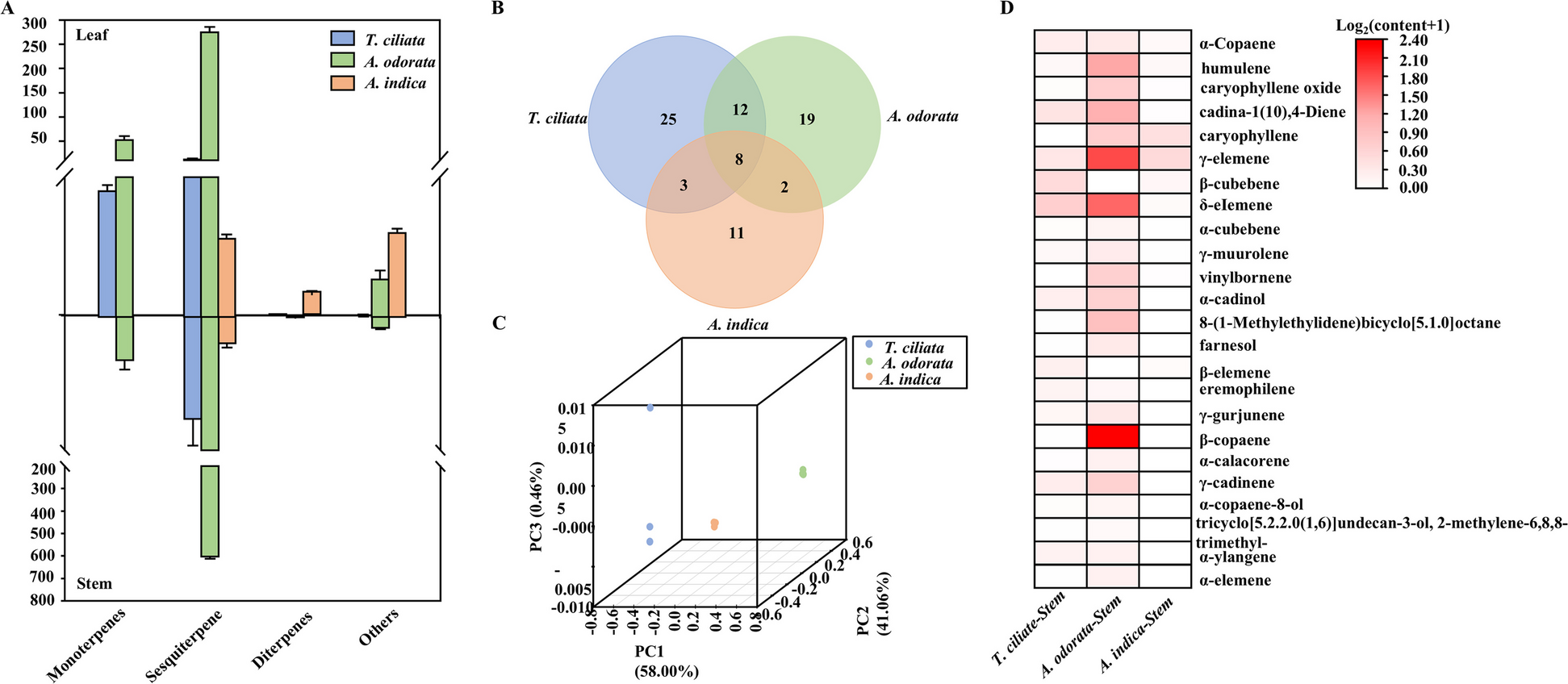
Meliaceae species are known for producing diverse metabolites, yet the role of whole-genome duplication (WGD) in shaping this diversity remains unclear. In this study, we analyzed volatile metabolites in Azadirachta indica, Toona ciliata and Aglaia odorata, finding terpenes to be most abundant in A. odorata. A high-quality genome assembly of A. odorata revealed lineage-specific whole-genome triplication (WGT), the first reported in Meliaceae. Comparative genomics indicated extensive chromosomal rearrangements, biased gene retention, gene expression, and long terminal repeat (LTR) insertions during the evolution of subgenomes in Meliaceae, with A. odorata showing subgenome dominance. Despite a reduction in terpene synthase (TPS) gene copies, the specifically highly expression of AodTPS25, AodTPS21, AodTPS24 and AodTPS26 in A. odorata could be crucial for its terpene abundance and diversity through transcriptomics and enzyme assays. Moreover, the ethylene response factor AodERF27 was found to activate AodTPS26, linking transcriptional regulation to terpene diversity. These findings uncovered the genomic and molecular mechanisms in Meliaceae.