2026-04-28 東京大学
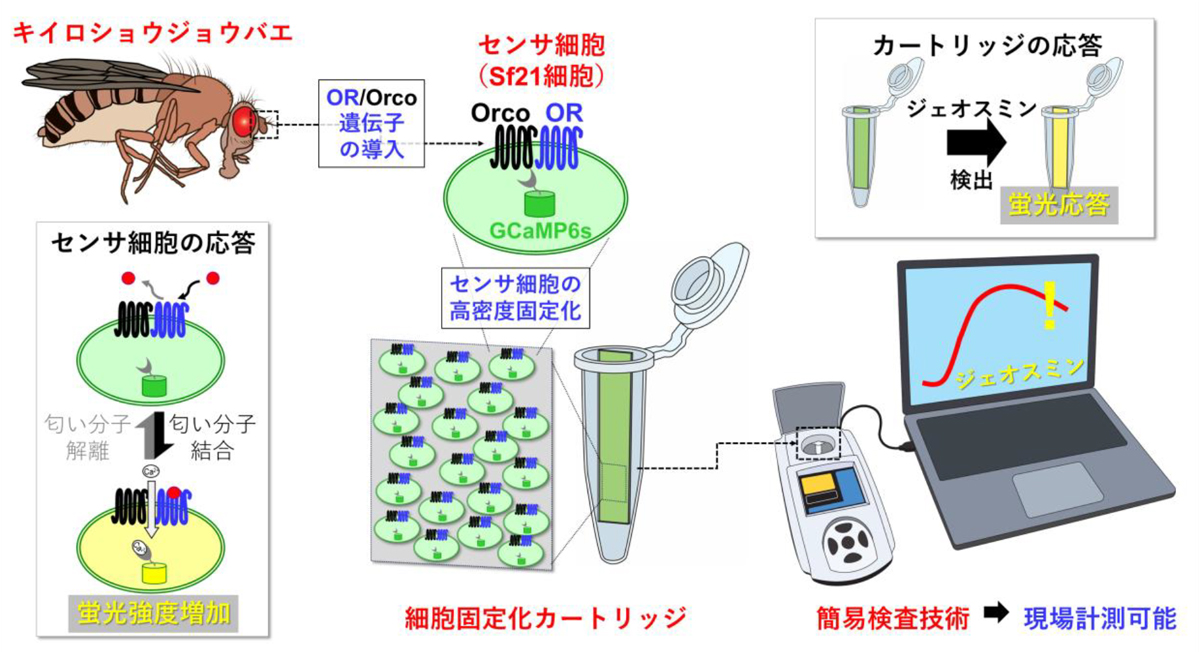
昆虫の嗅覚受容体を活用したセンサ細胞による簡易検査技術
OR:嗅覚受容体、Orco:共受容体、GCaMP6s:カルシウム感受性蛍光タンパク質
<関連情報>
- https://www.rcast.u-tokyo.ac.jp/ja/news/release/20260428.html
- https://www.nature.com/articles/s41598-026-41786-8
昆虫の嗅覚受容体を発現するセンサー細胞に基づく携帯型ジオスミン検出システム Portable geosmin detection system based on sensor cells expressing insect odorant receptors
Hidefumi Mitsuno,Shogo Araki,Yuji Sukekawa,Daigo Terutsuki,Sawako Niki,Eri Kuroda,Shunsuke Fujibayashi,Takeshi Sakurai,Kumiko Oguma,Satoshi Yamaguchi,Shinya Yamahira,Teruyuki Nagamune & Ryohei Kanzaki
Scientific Reports Published:28 April 2026
DOI:https://doi.org/10.1038/s41598-026-41786-8
Abstract
A technology that enables highly sensitive, selective on-site detection of odorants without sophisticated equipment could be valuable for a range of applications, from water quality testing to disease diagnosis. In this study, we introduce a portable technology using Sf21 cells engineered to express Drosophila melanogaster odorant receptors, co-receptors, and calcium-sensitive fluorescent proteins for geosmin detection—a natural compound known for its distinct musty odor. Sensor cartridges were fabricated by immobilizing sensor cells on the glass surface inside tubes. When coupled with a portable fluorometer, the system successfully detected geosmin at concentrations as low as 100 pM (18.2 ppt) without requiring any concentration steps. Moreover, the system was deployed at a lakeside dam and detected geosmin in real field samples. This is the first successful detection of target odorants using biosensors comprising transfected sensor cells bearing specific odorant receptor genes. The results highlight the practicality of insect odorant receptor-expressing sensor cells and reveal the potential of this technology in various applications, such as food, beverage, and water quality testing, where on-site odorant detection is required.