2026-05-19 東京農工大学
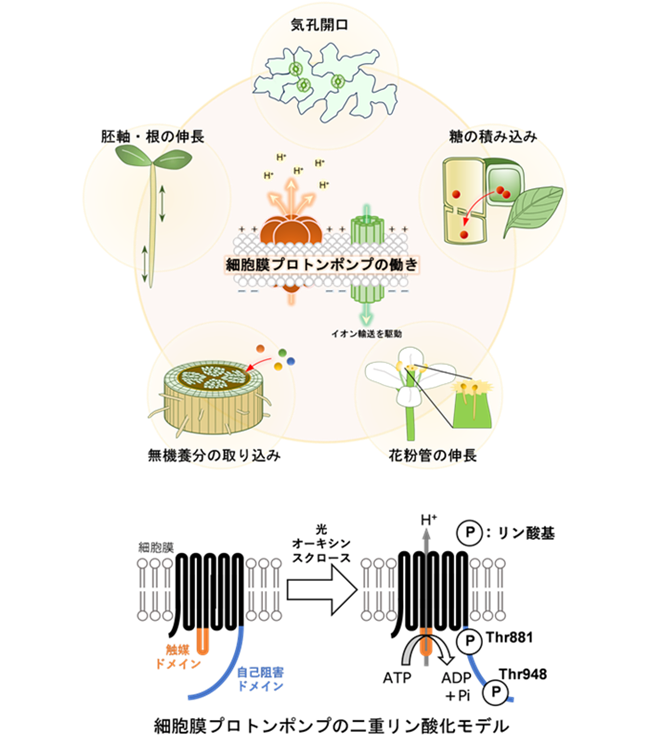
図1:細胞膜プロトンポンプは植物の生命活動のメインエンジンである
<関連情報>
- https://www.tuat.ac.jp/outline/disclosure/pressrelease/2026/20260519_01.html
- https://www.science.org/doi/10.1126/science.adx9533
Raf様タンパク質キナーゼヘテロ複合体は植物形質膜H + -ATPaseを直接制御する Raf-like protein kinase heterocomplexes directly regulate the plant plasma membrane H+-ATPase
Hinano Takase, Aina Nagano, Shota Yamauchi, Yuki Hayashi, […] , and Taishi Umezawa
Science Published:14 May 2026
DOI:https://doi.org/10.1126/science.adx9533
Editor’s summary
Although animals generally use sodium ions to regulate ionic balance across membranes, plants use a proton pump instead. Takase et al. identified a group of C-type Raf-like protein kinases that phosphorylate plasma membrane H+ ATPases in both the flowering plant Arabidopsis thaliana and the distantly related liverwort Marchantia polymorpha. The C5 and C7 Rafs form a heterocomplex to phosphorylate a threonine residue on the proton pump, thereby regulating the opening of stomatal pores in response to light. These findings point to an evolutionarily conserved mechanism to regulate the activity of a fundamental ion pump in plants. —Madeleine Seale
Abstract
The plasma membrane proton pump [PM H+-adenosine triphosphatase (PM H+-ATPase)] is essential in plants. C-terminal phosphorylation events regulate proton pump activity, such as Thr881 phosphorylation in Arabidopsis AHA1. We discovered a sequential protein phosphorylation pathway in which two distinct types of Raf-like protein kinases, C5-Raf and C7-Raf, form a heterocomplex that phosphorylates Thr881 to activate PM H+-ATPases. This regulatory system is highly conserved across lineages from liverworts to angiosperms. In Arabidopsis, a C5-Raf Raf36 regulates plant growth through the phosphorylation of multiple Arabidopsis H+-ATPases (AHAs). Additionally, another C5-Raf HT1 functions with C7-Rafs CBC1/2 to phosphorylate AHA1T881, thereby generating a driving force for light-induced stomatal opening. Our findings provide a framework for understanding PM H+-ATPase activation in various physiological processes, particularly in elucidating the complete mechanistic understanding of light-induced stomatal opening.