2026-05-20 東京大学
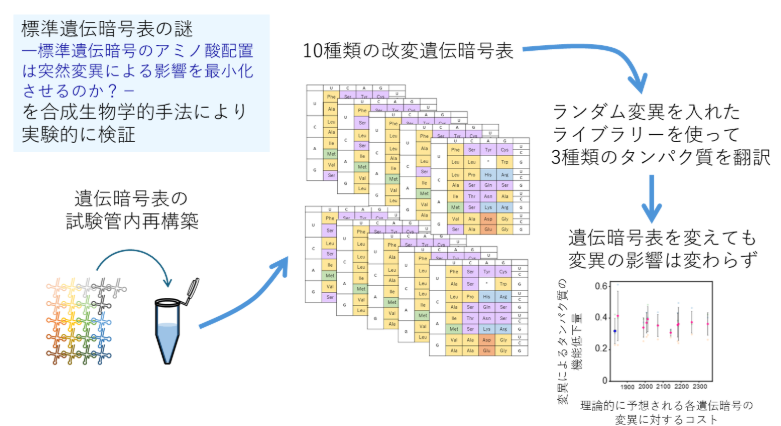
標準遺伝暗号表の謎を合成生物学的手法により実験的に検証
<関連情報>
- https://www.c.u-tokyo.ac.jp/info/news/topics/20260520140000.html
- https://elifesciences.org/reviewed-preprints/111164
試験管内で構築された非標準遺伝暗号を用いたエラー最小化理論の実験的検証 Experimental verification of the error minimization theory using non-standard genetic codes constructed in vitro
Ryota Miyachi,Norikazu Ichihashi
eLife Reviewed Preprint version 1: May 19, 2026
DOI:https://doi.org/10.7554/eLife.111164.1
Abstract
All living systems use an almost identical genetic code, the standard genetic code, in which 20 amino acids are assigned to 61 codons non-randomly. According to the error minimization theory, amino acids are arranged to minimize the mutational effect on protein function, while experimental verification remains limited. In this study, we constructed 10 non-standard genetic codes in vitro by reassigning three amino acids (Ala, Ser, and Leu) in vacant codons of the minimal genetic code, which consists of 21 tRNAs. Most of these non-standard genetic codes have a higher cost of amino acid replacement than the standard genetic code, calculated based on three amino acid properties: polar requirement (PR), molecular volume (MV), and hydropathy index (HI). The protein function of three reporter genes expressed using these non-standard genetic codes decreased similarly when random mutations were introduced into the genes, implying that the effect of mutations was similar across all the non-standard genetic codes tested here. This result provides direct experimental evidence that mutational robustness does not significantly change when the genetic code is altered within the range of mutational cost tested in this study (CostPR: 5.29 – 5.77, CostMV: 1848 – 2348, and CostHI: 3.27 – 5.10), which covers approximately 18.4% (PR), 37.6% (MV), and 50.8% (HI) of possible cost range achievable among one million randomly-generated genetic codes.