
2026-05-22 ペンシルベニア州立大学(Penn State)
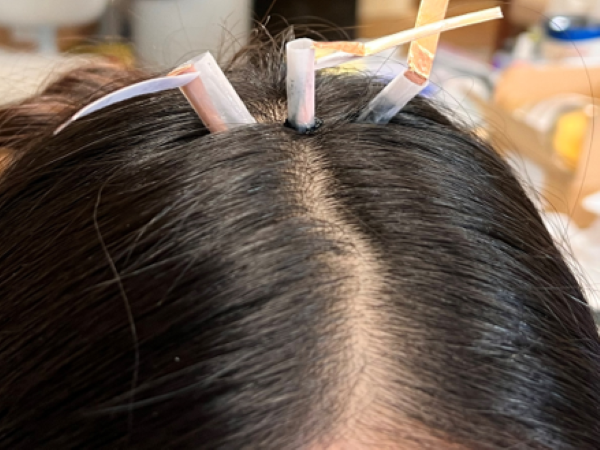
EEG electrodes are placed through hair during testing of a biogel designed by Penn State researchers to improve contact with the scalp for wearable brain-monitoring systems. The reusable material softens with gentle heat, reaches the skin and gels again as it cools. Credit: Ankan Dutta. All Rights Reserved.
<関連情報>
- https://www.psu.edu/news/materials-research-institute/story/novel-biogel-may-solve-hairy-problem-wearable-brain-monitoring
- https://www.science.org/doi/10.1126/sciadv.aee0777
相形態を利用したニューロハプティクス向け感温性イオン性バイオゲルの熱可逆性と正孔伝導性の制御 Controlling thermoreversibility and hole conductivity in thermoresponsive ionic biogels using phase morphology for neurohaptics
Ankan Dutta, Md Abu Sayeed Biswas, Ethan Gerhard, Mayukh Das, […] , and Huanyu Cheng
Science Advances Published:15 May 2026
DOI:https://doi.org/10.1126/sciadv.aee0777
Abstract
Integrating thermoreversibility with electrical conductivity in a unified hydrogel platform enables long-term, reusable through-hair neural interfaces. However, achieving both simultaneously remains challenging, as thermoreversibility demands network reorganization while conductivity necessitates network percolation. Here, we engineer phase morphology by controlling the components’ viscoelastic state during mixing. Ionically conductive nucleated morphologies illustrated by liquid-liquid phase separation exhibit rapid thermoreversibility, whereas electrically conductive bicontinuous phases demonstrated by viscoelastic phase separation achieve a marginal gel-sol transition and an ultralow storage modulus of ~1.7 kilopascals while simultaneously achieving a conductivity of 7.5 siemens per centimeter or transconductance of 5.1 millisiemens in an organic electrochemical transistor. Below this threshold, systems resemble nucleated behavior, whereas above it, superior semiconducting properties emerge, but phase transition capability is lost. These materials enable reusable through-hair neural interfaces to maintain low skin contact impedance of 1.6 kohm·cm2 across different hair types for 3 days, facilitating stable event-related desynchronization detection during mechanical and electrical haptic sensation for personalized haptics.
00470-X/asset/3bb15f3c-3323-44f2-8871-31738361a4ee/main.assets/gr1.jpg "イベルメクチンによるマラリア抑制可能性 (Ivermectin could help beat malaria, veterinary college researcher finds in running the numbers)")
