2026-06-11 東京大学
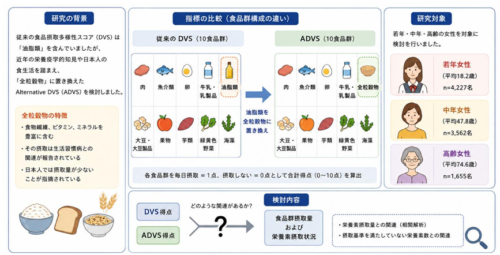
本研究の概要図
<関連情報>
- https://www.u-tokyo.ac.jp/content/400289615.pdf
- https://www.frontiersin.org/journals/nutrition/articles/10.3389/fnut.2026.1848503/full
代替的な食事多様性スコアは、日本人女性の様々なライフステージにおける栄養素の充足度を反映している An alternative dietary variety score reflects nutrient adequacy across different life stages in Japanese women
Yuko Tateishi,Hidehiro Nakamura,Ryoko Tajima,Naoki Hayashi,Kentaro Murakami,Hitomi Okubo
Frontier in Nutrition Published:11 June 2026
DOI:https://doi.org/10.3389/fnut.2026.1848503
Abstract
Background:
The Dietary Variety Score (DVS) is a simple indicator of dietary variety widely used in Japan, particularly among older adults. However, its applicability to younger populations remains uncertain, and some components—most notably “fats and oils”—may not fully reflect current nutritional priorities, including the promotion of whole grains for the prevention of noncommunicable diseases. We developed an Alternative Dietary Variety Score (ADVS) and examined whether the original and alternative scores capture food group and nutrient intake, as well as nutrient adequacy, among women across different life stages.
Methods:
The cross-sectional study included 4,227 young (mean age 18.2 years), 3,562 middle-aged (47.8 years), and 1,655 older (74.6 years) Japanese women. Dietary intake was assessed using a comprehensive Diet History Questionnaire for young and middle-aged women and a brief-type Diet History Questionnaire for older women. The DVS was calculated based on the weekly consumption frequency of ten food groups, assigning one point for each food group consumed at least once per day. The ADVS retained the original scoring framework but replaced “fats and oils” with “whole grains.” Associations with food groups and nutrient intake were examined using Spearman’s rank correlation coefficients, and nutrient adequacy was evaluated based on the Dietary Reference Intakes for Japanese.
Results:
Both DVS and ADVS were positively associated with the intake of vegetables, fruits, fish and shellfish, eggs, soy products, dairy, seaweeds, and potatoes. The ADVS additionally reflected whole-grain consumption, while correlations with fats and oils were attenuated. Both scores were positively correlated with intakes of protein, dietary fiber, vitamins, and minerals across age groups. Higher scores were associated with a lower prevalence of inadequate nutrient intake across all age groups. The ADVS showed somewhat higher correlations with dietary fiber, vitamins B1, B2 and B6, and calcium, iron, and magnesium.
Conclusion:
Both the DVS and ADVS are useful proxies of nutrient adequacy among young, middle-aged, and older Japanese women. The ADVS additionally reflected whole-grain consumption and showed a different pattern of correlations with several nutrients, suggesting that incorporating whole grains into a dietary variety index may provide an alternative perspective on dietary variety while maintaining simplicity.