
2026-06-15 名古屋大学
<関連情報>
- https://www.nagoya-u.ac.jp/researchinfo/result/2026/06/post-1011.html
- https://www.cell.com/patterns/fulltext/S2666-3899(26)00030-9
- https://www.nagoya-u.ac.jp/researchinfo/result/upload_images/20260615_med_ja.pdf
変異体空間トランスクリプトームのゼロショット再構築 Zero-shot reconstruction of mutant spatial transcriptomes
Yasushi Okochi ∙ Takaaki Matsui ∙ Shunta Sakaguchi ∙ Takefumi Kondo ∙ Honda Naoki
Patterns Published: March 31, 2026
DOI:https://doi.org/10.1016/j.patter.2026.101521
The bigger picture
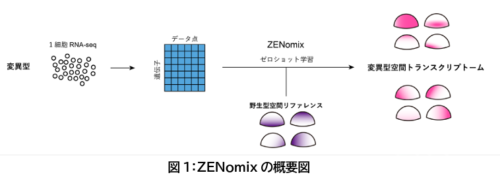
Understanding how genes are spatially organized in tissues is essential for uncovering mechanisms of disease and developmental disorders. Spatial transcriptomics technologies allow researchers to map gene activity across tissues, but their high cost and technical complexity limit their use to a small number of conditions. By contrast, single-cell RNA sequencing has become widely adopted, producing gene expression data from hundreds of mutant and disease models. However, this approach loses spatial information when tissues are dissociated into individual cells. Existing computational methods can recover spatial information by referencing spatial gene expression atlases, but such atlases are unavailable for most mutant and disease conditions. We introduce ZENomix, a zero-shot-learning framework that predicts spatial transcriptomes of mutant or diseased tissues using only a wild-type spatial atlas as side information, without requiring any mutant-specific spatial data. This approach takes advantage of shared spatial coordinate systems between wild-type and mutant tissues. ZENomix enables researchers to identify genes with spatially disrupted expression patterns, offering improved biological insight beyond conventional differential expression analysis. We validate ZENomix across multiple species and disease contexts and demonstrate its utility for discovering genes with perturbed spatial expression. Without the need for mutant-specific spatial references, ZENomix enables spatial analysis of the vast existing single-cell RNA sequencing data from mutant and disease conditions, with potential implications for understanding disease pathology and developmental biology.
Highlights
- ZENomix predicts mutant spatial transcriptomes in a zero-shot manner using GPLVM and MMD
- ZENomix accurately reconstructs spatial transcriptomes in disease and mutant
- Spatially informed screening identified eight Nodal-downregulated genes in zebrafish
Summary
Mutant analysis is the core of biological/pathological research, and measuring spatial transcriptomes can facilitate the understanding of the disorganized tissue phenotype. However, the high cost and technical challenges of spatial transcriptome experiments hinder the investigation of large numbers of mutants. Spatial transcriptomes have also been computationally predicted from single-cell RNA sequencing data using teaching data of spatial expression of certain genes, but the lack of teaching data for most mutants remains challenging. In various machine-learning tasks, zero-shot learning offers potential for predictions without teaching data. Here, we provided ZENomix, the zero-shot framework for predicting mutant spatial transcriptomes without teaching data (e.g., mutant spatial atlases). ZENomix accurately predicted spatial transcriptomes in Alzheimer’s model mice, Alzheimer’s human brains, and Nodal-signaling-deficient mutant zebrafish embryos. We proposed a ZENomix-based screening approach, identifying Nodal-downregulated genes in zebrafish. We expect that ZENomix offers phenotypic insights by leveraging the enormous amount of mutant/disease single-cell RNA sequencing data.
