2026-06-19 東北大学
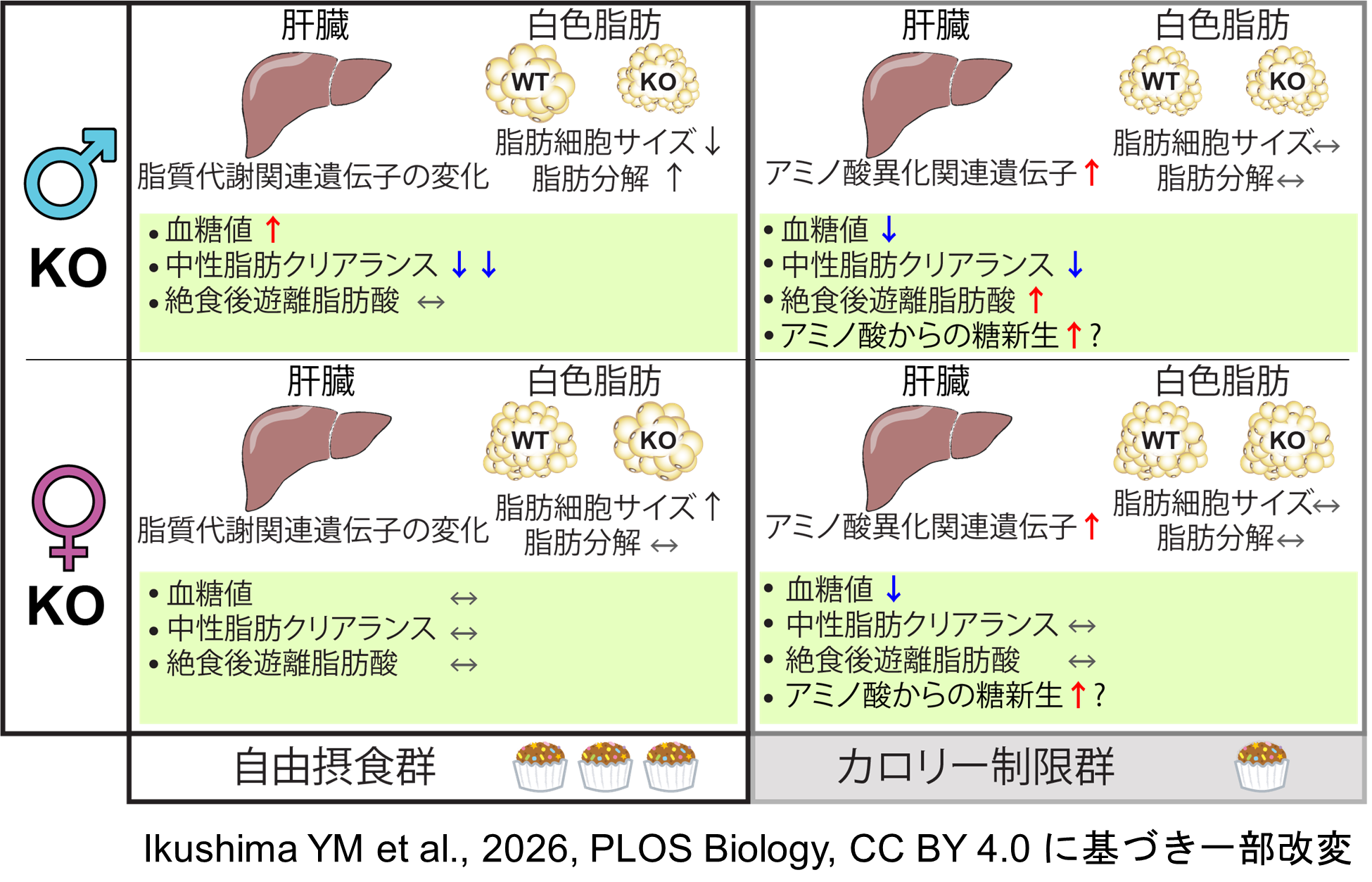
図1. アディポネクチン欠損マウス(KO)解析によって、アディポネクチンの機能が食事条件や性別によって異なることが示された。
<関連情報>
- https://www.tohoku.ac.jp/japanese/2026/06/press20260619-02-adiponectin.html
- https://journals.plos.org/plosbiology/article?id=10.1371/journal.pbio.3003821
アディポネクチンは、カロリー制限中の脂質、アミノ酸、およびグルコース代謝に性別依存的な影響を及ぼす Adiponectin exerts sex-dependent effects on lipid, amino acid, and glucose metabolism during caloric restriction
Yoshiko M. Ikushima,Kuan-Chan Chen,Richard J. Sulston,Domenico Mattiucci,Eleanor J. Brain,Stefanie A. Fung Xin Zi,Karla J. Suchacki,Benjamin J. Thomas,Andrea Lovdel,Matthew Bennett,Hiroshi Kobayashi,Phillip D. Whitfield,Keiyo Takubo, [ … ],William P. Cawthorn
PLOS Biology Published: June 18, 2026
DOI:https://doi.org/10.1371/journal.pbio.3003821
Abstract
Adiponectin is the most abundant hormone in the circulation. Plasma adiponectin decreases in obesity but increases in leanness, including during caloric restriction (CR) in animals and humans. In obesity, adiponectin deficiency promotes cardiometabolic dysfunction. In contrast, the roles of adiponectin in CR, when it is at its highest, are largely unknown. To address this, we studied global adiponectin knockout (KO) in male and female mice fed either ad libitum (AL) or a 30% CR diet from 9–13 weeks of age. We show that adiponectin KO did not alter CR effects on body mass, body composition, or energy expenditure. However, KO unexpectedly decreased blood glucose levels during CR, both with fasting and following an oral glucose challenge. This is opposite to the effects of adiponectin deficiency during AL feeding or obesity and occurred without changes in insulin concentrations or sensitivity. Moreover, adiponectin KO augmented CR-induced increases in plasma fatty acids in both sexes and, in males only, impaired systemic triglyceride clearance on both AL and CR diets. These effects on lipid metabolism were associated with sex- and diet-specific KO effects on white adipose tissue, including altered adipocyte size and expression of key regulators of adipocyte lipid metabolism. Indirect calorimetry further revealed that adiponectin KO alters the shifts between carbohydrate and lipid utilization that occur during transitions between fed and fasted states. To determine potential molecular mechanisms, we investigated effects of adiponectin KO on the liver, a major adiponectin target that plays key roles entraining metabolism to nutritional state. Hepatic transcriptomics revealed that, in both sexes, adiponectin KO upregulates sterol and fatty acid synthesis genes under AL while increasing amino acid catabolic genes during CR. However, the latter occurred without altering plasma or hepatic amino acid concentrations. Together, our findings suggest that adiponectin exerts sexually dimorphic effects on glucose, lipid, and amino acid metabolism during CR, in whole or in part through effects on the liver. Thus, the roles adiponectin in CR differ markedly from its widely reported functions in obesity, insulin resistance, and other pathological states.