2026-06-30 東京科学大学
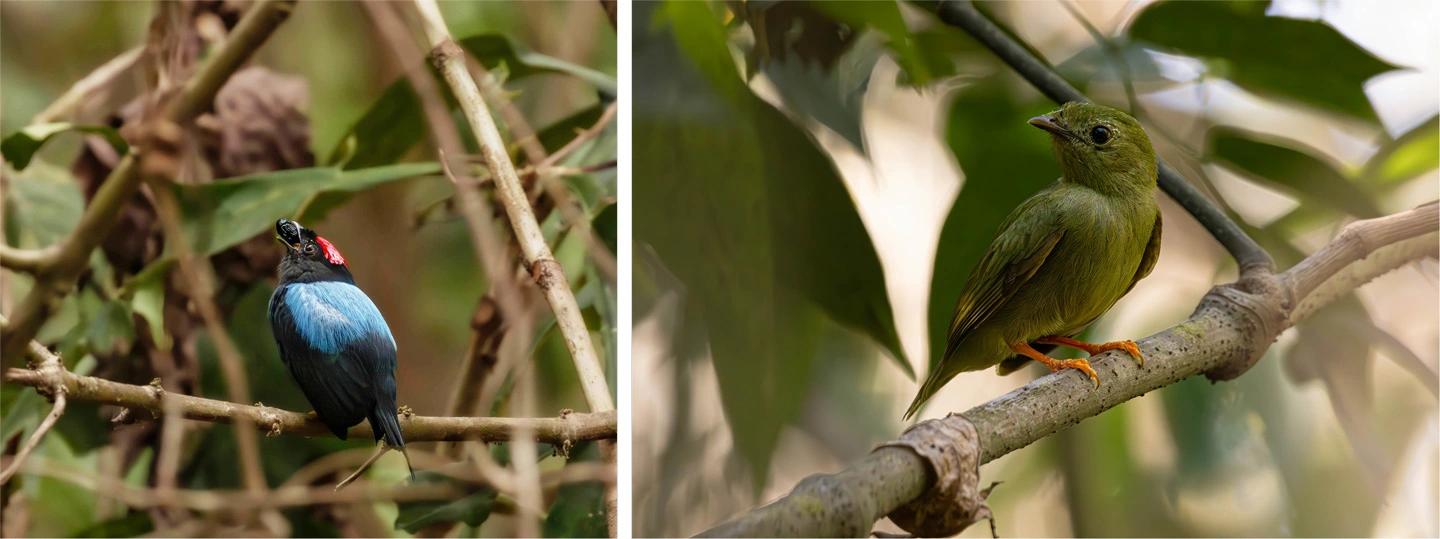
図1. Lance-tailed manakin(Chiroxiphia lanceolata(学名)、ハリオセアオマイコドリ)。メス(右)と比較して、オス(左)は鮮やかな羽色を有す。果実食に特化している。Photographer: Esteban Mendez, Location: Isla Boca Brava, Panama
<関連情報>
- https://www.isct.ac.jp/ja/news/qkeq5dzoqdmo
- https://www.cell.com/current-biology/fulltext/S0960-9822(26)00625-1
性的選択を受けた果実食鳥類の放散におけるゲノムおよび生理学的変化 Genomic and physiological changes in a sexually selected and frugivorous bird radiation
Christopher N. Balakrishnan ∙ Yasuka Toda ∙ Meng-Ching Ko ∙ … ∙ Bette A. Loiselle ∙ Michael J. Braun ∙ Maude W. Baldwin
Current Biology Published:June 10, 2026
DOI:https://doi.org/10.1016/j.cub.2026.05.021
Highlights
- Sensory system, muscle, and diet-related genes show signatures of selection
- Sweet sensing (through T1R1-T1R3) evolved at the base of the manakin radiation
- Reduced lactase-phlorizin hydrolase activity coincided with an early diet shift
- Shifts in breeding systems and plumage are linked with transitions to frugivory
Summary
Across diverse organisms, the strength and ecological drivers of sexual selection vary enormously. In birds, some of the families with the most elaborate plumage and display—such as birds of paradise, manakins, and cotingas—are also specialist frugivores, yet links between shifts in diet, changes in breeding system, and the evolution of elaborate traits are poorly understood. We focus on manakins, a radiation of frugivorous Neotropical birds well known for spectacular courtship rituals and colorful plumage, and present an integrative analysis of the transition in both diet and mating systems in this clade to examine the causes and consequences of strong sexual selection. In manakins, we find reduced genetic diversity on the Z sex chromosome relative to autosomes, a predicted signature of sexual selection. We also identify targets of positive selection across the manakin radiation, including genes related to muscle function, visual perception, and the transition to frugivory. Among these, we observe selection on sugar-sensing taste receptors, as well as on lactase-phlorizin hydrolase, implicated in the consumption of chemically defended fruits. For both, we confirm that selection signatures correspond to functional changes and infer the relative time of these changes, as well as of shifts in diet, breeding systems, and plumage coloration: elaborated traits evolved subsequent to changes in mating systems and after key physiological changes facilitating fruit-eating. Altogether, these results suggest that intensified frugivory set the stage for the radiation of one of the planet’s most colorful and acrobatic avian lineages.