2026-07-03 テキサスA&M大学
<関連情報>
- https://stories.tamu.edu/news/2026/07/03/innovative-algorithm-makes-genomic-surveillance-faster-and-more-affordable-for-global-disease-outbreaks/
- https://www.nature.com/articles/s41467-026-70664-0
新たなSARS-CoV-2変異株の早期発見のためのグローバルゲノム監視の最適化 Optimizing global genomic surveillance for early detection of emerging SARS-CoV-2 variants
Haogao Gu,Jifan Li,Wanying Sun,Mengting Li,Kathy Leung,Joseph T. Wu,Hsiang-Yu Yuan,Maggie H. Wang,Bingyi Yang,Matthew R. McKay,Ning Ning & Leo L. M. Poon
Nature Communications Published:14 March 2026
DOI:https://doi.org/10.1038/s41467-026-70664-0
Abstract
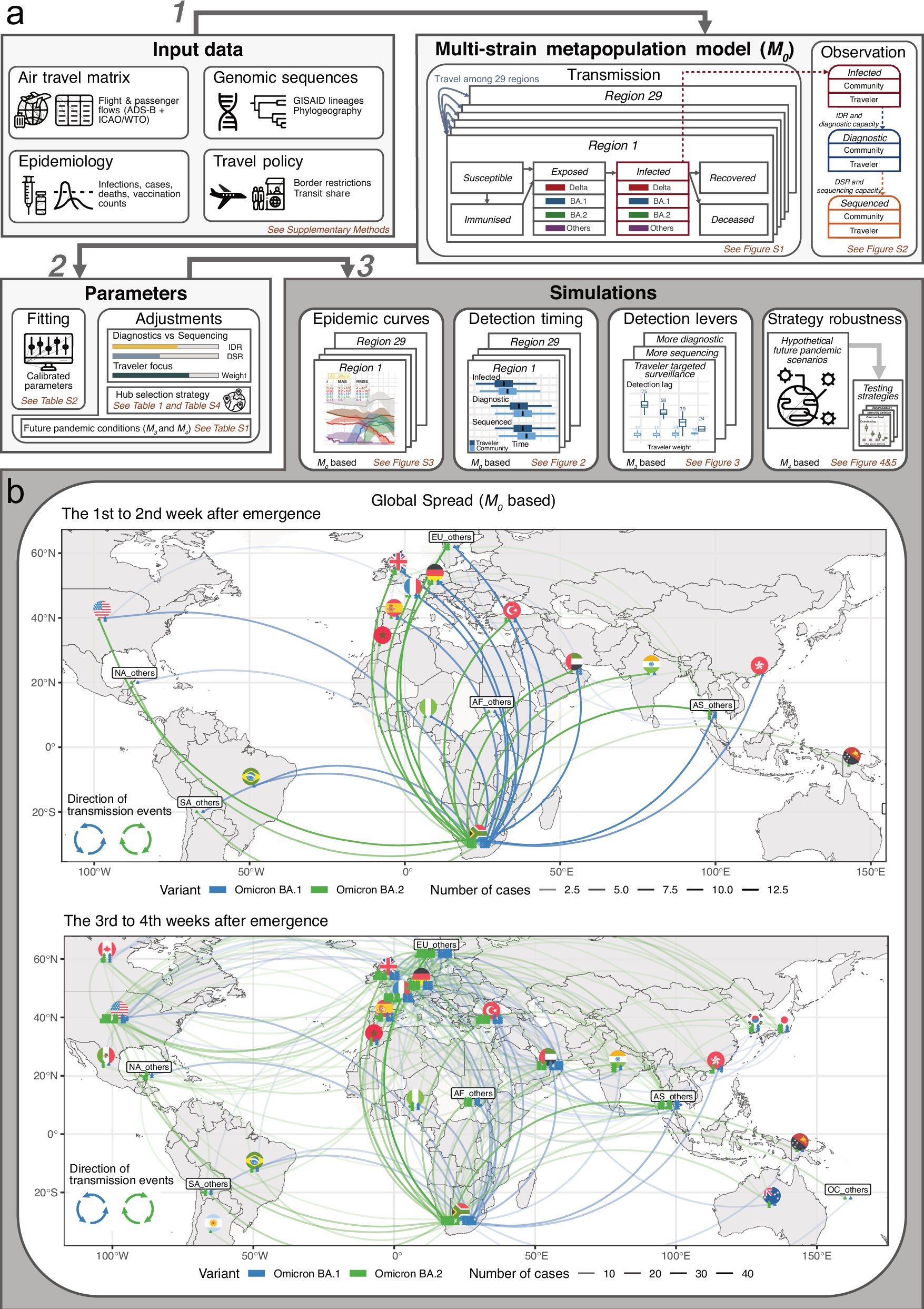
The global spread of viruses highlights the need for timely and effective genomic surveillance to detect new variants and inform rapid public health responses. However, high costs and uneven sequencing capacity hinder equitable global implementation. Surveillance focused on international travelers at major travel hubs has been proposed as a way to complement robust local surveillance, but its potential benefits have not been fully quantified. Here, we develop and calibrate a multiple-strain metapopulation model of global SARS-CoV-2 transmission using extensive epidemiological, phylogenetic, and high-resolution air travel data. Retrospective analyses of the Omicron BA.1/BA.2 emergence and forward simulations for hypothetical novel variants show that targeted enhancement of traveler surveillance at key hubs can shorten variant detection delays, with reduced total surveillance efforts. Practical “non-disruptive” strategies, such as prioritizing a small number of highly connected hubs, consistently outperformed baseline approaches and remained effective across a range of variant transmissibility and vaccine effectiveness scenarios. These results provide a quantitative framework for strengthening global genomic surveillance through targeted, complementary strategies that preserve local capacity while improving preparedness for future pandemics.