2026-07-09 京都大学,科学技術振興機構
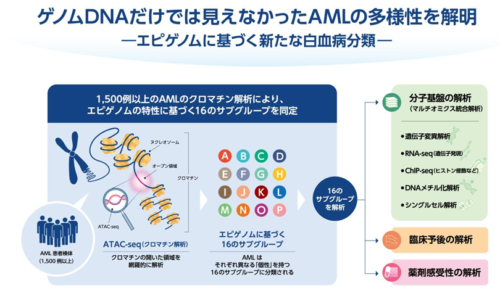
本研究概要図
<関連情報>
- https://www.jst.go.jp/pr/announce/20260709/index.html
- https://www.nature.com/articles/s41586-026-10703-4
急性骨髄性白血病におけるクロマチン構造とエピゲノム多様性の解明 Chromatin landscape and epigenetic heterogeneity of acute myeloid leukaemia
Yotaro Ochi,Markus Liew-Littorin,Yasuhito Nannya,Sofia Bengtzen,Benedicte Piauger,Stefan Deneberg,Martin Jädersten,Vladimir Lazarevic,Jörg Cammenga,Anna Robelius,Lovisa Wennström,Emma Ölander,Senji Kasahara,Nobuhiro Hiramoto,Nobuhiro Kanemura,Nobuo Sezaki,Maki Sakurada,Makoto Iwasaki,Junya Kanda,Yasunori Ueda,Satoshi Yoshihara,Tom Erkers,Nona Struyf,Yu Watanabe,… Seishi Ogawa
Nature Published:08 July 2026
DOI:https://doi.org/10.1038/s41586-026-10703-4
Abstract
Acute myeloid leukaemia (AML) is an aggressive blood cancer characterized by the unregulated proliferation of immature myeloblasts. Gene mutations have been shown to have a large effect on pathogenesis, inter-tumour heterogeneity and clinical outcomes in AML1,2,3,4,5,6,7,8; however, the role of epigenetic alterations in these respects has been investigated less extensively. Here we use ATAC-seq (assay for transposase-accessible chromatin with sequencing) in a cohort of 1,563 individuals with a recent diagnosis of AML (the ‘eCHROMA’ cohort) to show that AML can be classified into 16 subgroups on the basis of chromatin accessibility profiles. Multiomics analyses of gene mutations, the transcriptome, DNA methylation and histone marks show that these ATAC subgroups exhibit distinct driver mutations, differentiation states, gene expression, DNA methylation and super-enhancer profiles, and are also associated with clinical outcomes. These findings were validated in independent cohorts. Single-cell ATAC sequencing reveals that all leukaemic cells in each subgroup share a common chromatin accessibility profile, which suggests that subgroup-specific epigenomic fingerprints underlie the ATAC-based classification. Mechanistically, the subgroups have distinct gene-regulatory networks that are driven by the activities of key transcription factors in haematopoiesis, and in which subgroup-specific super-enhancers have a pivotal role. Multiomics single-cell analysis further reveals deregulated trajectories of differentiation coupled with chromatin accessibility and gene expression. Notably, ATAC subgroups have an independent prognostic effect, compared with genomic classification, and are associated with particular drug sensitivities. In summary, ATAC-based chromatin profiling, combined with multiomics data, provides insights into AML pathogenesis beyond genomics and constitutes a valuable resource for AML research.