2026-07-22 ロックフェラー大学
<関連情報>
- https://www.rockefeller.edu/news/40149-flies-use-directional-memory-to-track-a-scent/
- https://www.nature.com/articles/s41586-026-10827-7
ショウジョウバエの嗅覚ナビゲーションのためのベクターベース戦略 A vector-based strategy for olfactory navigation in Drosophila
Andrew F. Siliciano,Sun Minni,Chad Morton,Charles K. Dowell,Noelle B. Eghbali,Silas E. Busch,Juliana Y. Rhee,L. F. Abbott & Vanessa Ruta
Nature Published:22 July 2026
DOI:https://doi.org/10.1038/s41586-026-10827-7
Abstract
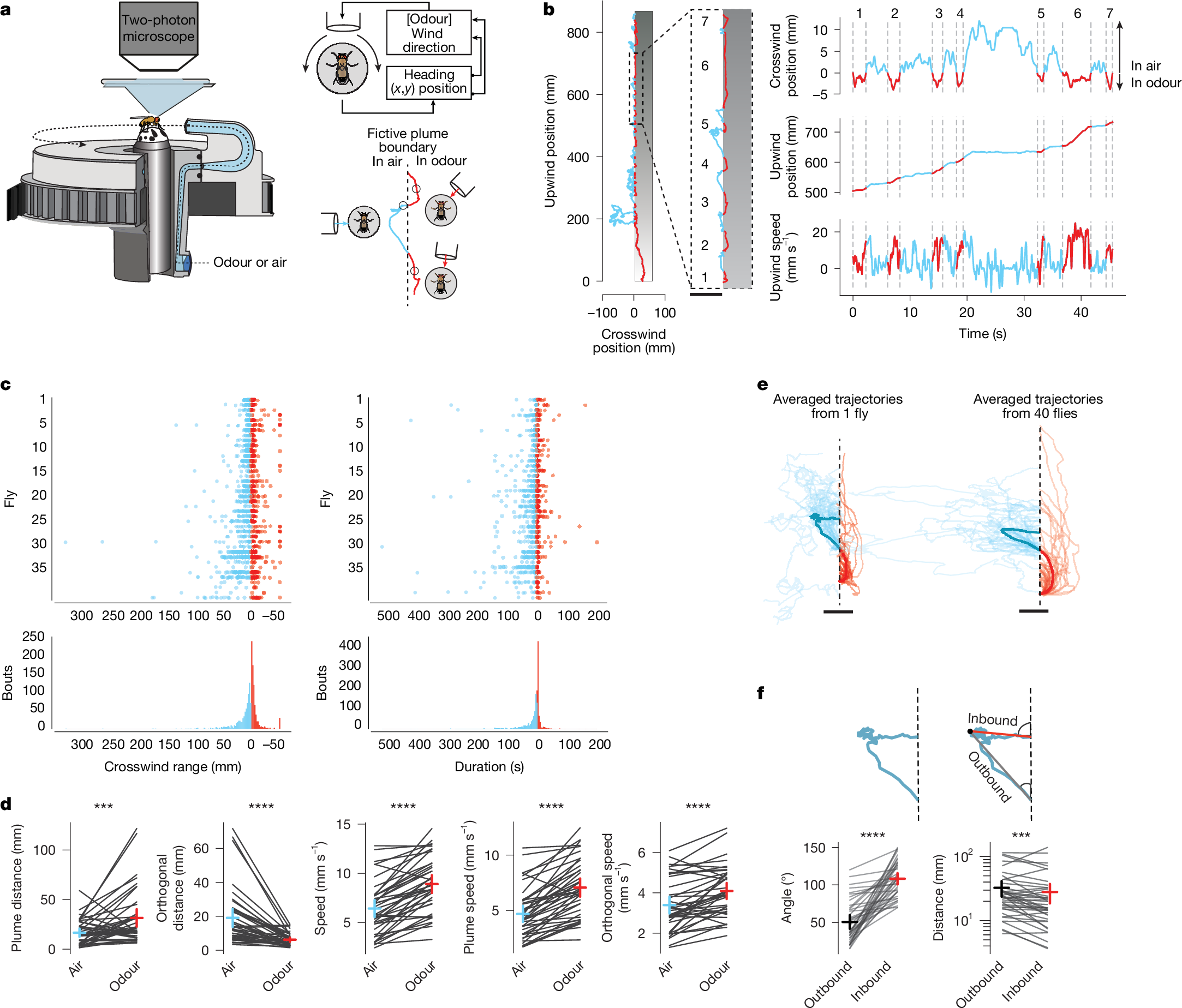
For many species, odours serve as key navigational cues1,2. Although tracking an odour plume has been modelled as a reflexive process3,4,5, it remains unclear whether animals can use memories of their past odour encounters to infer the spatial structure of their chemical environment or their location within it. Here we developed a virtual-reality olfactory paradigm that allows head-fixed Drosophila to explore structured chemical landscapes, offering insight into how memory mechanisms shape their navigational strategies. We found that flies track an appetitive odour corridor by following its boundary, alternating between rapid counter-turns to exit the plume and directed returns to its edge. Using a combination of behavioural modelling, functional calcium imaging and neural perturbations, we show that this ‘edge tracking’ strategy relies on vector-based computations within the Drosophila central complex, in which flies store and dynamically update memories of the direction to return to the plume’s boundary. Consistent with this, we find that FC2 neurons within the fan-shaped body, which encode a fly’s navigational goal6, signal the direction back to the odour boundary when flies are outside the plume. Plume tracking thus engages components of a conserved navigational toolkit, in which flies can use directional memories to navigate through complex and shifting chemical landscapes.