2026-07-28 横浜市立大学
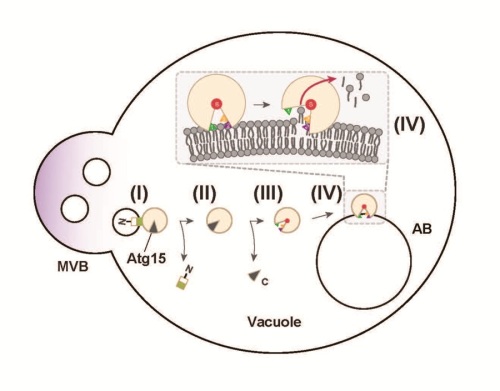
図1 液胞内におけるAtg15の活性化モデル。
<関連情報>
- https://www.yokohama-cu.ac.jp/res-portal/news/2026/20260728sakai.html
- https://www.pnas.org/doi/10.1073/pnas.2601290123
液胞リパーゼAtg15の膜認識と活性化の構造的および機構的基盤 Structural and mechanistic basis for membrane recognition and activation of the vacuolar lipase Atg15
Tomoko Kawamata, Nobuo N. Noda, Michiko Sasaki, +1 , and Yuji Sakai
Proceedings of the National Academy of Sciences Published:July 23, 2026
DOI:https://doi.org/10.1073/pnas.2601290123
Abstract
Atg15 is a vacuolar phospholipase B essential for the degradation of intravacuolar vesicles such as autophagic bodies. Despite its central role in cellular membrane turnover, the molecular basis of how Atg15 is activated and acts on internal membranes has remained elusive. Here, by combining all-atom and coarse-grained molecular dynamics (MD) simulations with in vitro and in vivo analyses, we elucidate the structural and mechanistic principles underlying Atg15 activation and substrate recognition. Our simulations revealed that disulfide bonds are critical for maintaining the structural integrity of the catalytic core, while the C-terminal region locks the catalytic center in a closed state that prevents activation. Membrane binding induces a transition to an open state, enabling catalysis. Through MD-guided mutational analysis, we identified three regions crucial for catalytic locking, membrane binding, and substrate recognition, and experimentally confirmed that mutations in these regions inhibit activity. Furthermore, Atg15 preferentially associates with positively curved membranes, providing a potential basis for its preferential action on internal vesicular membranes. These findings suggest that Atg15’s activity is controlled through multiple regulatory layers to ensure safe and preferential membrane degradation.