2026-07-29 東北大学
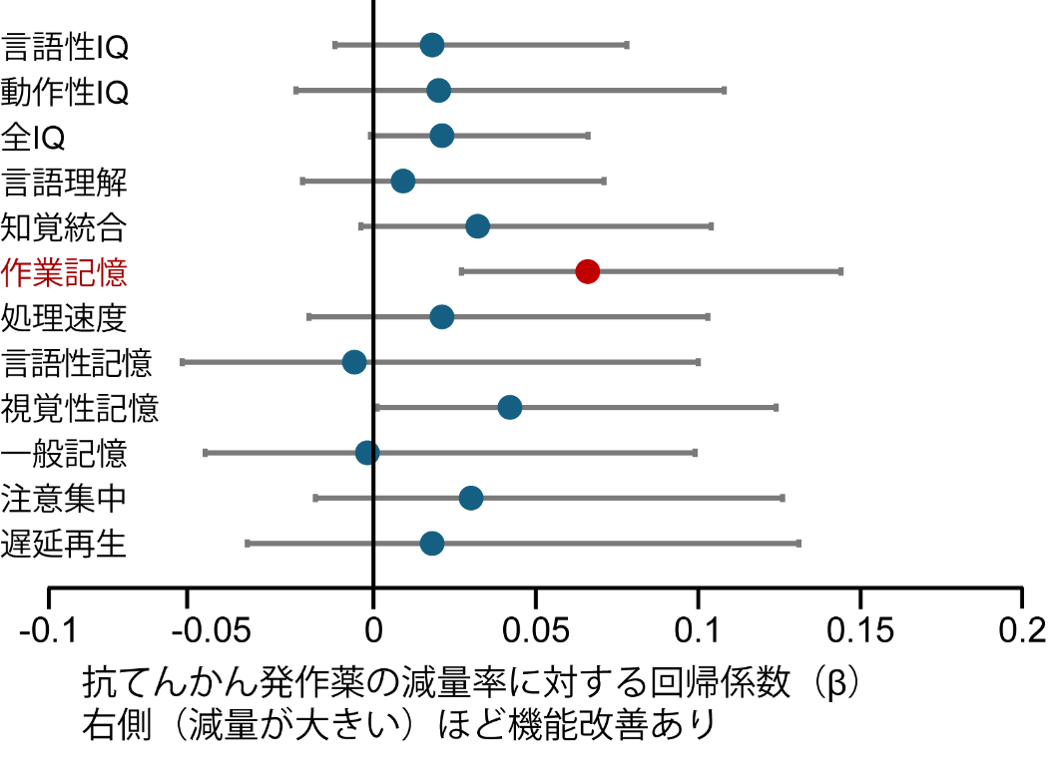
図1. 薬の減量と、各認知機能の変化との関連 点は関連の強さ(回帰係数β)、横線はその推定の幅(95%信頼区間)を示す。
<関連情報>
- https://www.tohoku.ac.jp/japanese/2026/07/press20260729-02-lobectomy.html
- https://onlinelibrary.wiley.com/doi/10.1002/epi.70395
前側頭葉切除術後の発作のない患者において、術後の抗てんかん薬の減量は認知機能の改善と関連している Postoperative reduction of anti-seizure medication is associated with cognitive improvement in seizure-free patients after anterior temporal lobectomy
Kazushi Ukishiro, Shin-ichiro Osawa, Maimi Ogawa, Makoto Ishida, Takafumi Kubota, Kazutoshi Konomatsu, Hidenori Endo, Kazutaka Jin
Epilepsia Published: 20 July 2026
DOI:https://doi.org/10.1002/epi.7039
Abstract
Objective
To determine whether postoperative reduction of anti-seizure medication (ASM) burden is associated with cognitive improvement after anterior temporal lobectomy (ATL) in seizure-free patients.
Methods
We retrospectively analyzed data for adult patients with drug-resistant temporal lobe epilepsy who underwent unilateral ATL between March 2013 and January 2025. Analyses were restricted to patients achieving complete freedom from seizures (Engel Class I) at 1 year. ASM burden was quantified using the prescribed daily dose/defined daily dose ratio, and the reduction rate was calculated. Preoperative and 1-year postoperative neuropsychological outcomes, including full-scale intelligence quotient (FSIQ) and domain-specific indices, were assessed. The effect of ASM reduction on cognitive change was evaluated using a doubly robust estimation framework integrating inverse probability of treatment weighting with multivariable outcome regression. Robustness and potential dose–response relationships were assessed via sensitivity analyses, analysis of covariance (ANCOVA), and categorical modeling.
Results
Fifty-seven seizure-free patients were included in the primary analysis (median age at surgery, 32 years; 33 female). Greater ASM reduction was significantly associated with improved working memory (WM) (β = .066, p = .001). A positive but non-significant trend was observed for FSIQ (β = .021, p = .062). A dose–response relationship was identified, with greater ASM reduction associated with progressively greater improvement in WM (p = .013). Findings were consistent across sensitivity and ANCOVA analyses.
Significance
Postoperative ASM reduction was associated with domain-specific cognitive improvement following ATL, particularly in WM. These findings support ASM tapering as a potentially modifiable factor influencing postoperative cognitive outcomes.
Key points
- Reduction of anti-seizure medication (ASM) burden after anterior temporal lobectomy was associated with cognitive improvement.
- The strongest association was observed in working memory.
- A dose–response relationship was identified, with greater ASM reduction associated with greater cognitive improvement.
- Findings were consistent across multiple analytical approaches.
- Postoperative ASM reduction may be considered to optimize cognitive outcomes, with careful attention to the risk of seizure recurrence.