2026-08-24 早稲田大学
<関連情報>
δ2-プロトカドヘリンは、平行な間接基底核回路を組織化する δ2-Protocadherins organize parallel indirect basal ganglia circuits
Naosuke Hoshina, Joshua M. Boeckers, Erin M. Johnson-Venkatesh, Miyuki Hoshina, […] , and Hisashi Umemori
Science Advances Published:21 Aug 2026
DOI:https://doi.org/10.1126/sciadv.aec8746
Abstract
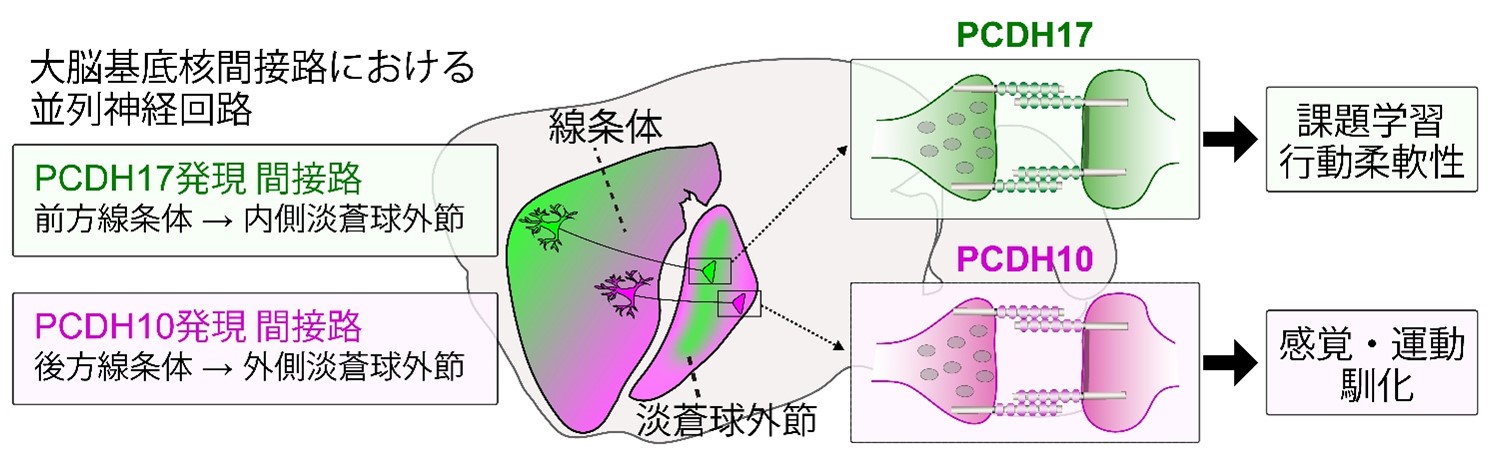
The basal ganglia (BG) contain multiple parallel neural circuits, each of which may control different behaviors. However, how the distinct parallel BG circuits are molecularly organized is not known. Here, we show that two δ2-protocadherins (PCDHs), PCDH17 and PCDH10, which are homophilic cell adhesion molecules, establish and define two distinct indirect BG circuits that regulate different behaviors. PCDH17 and PCDH10 are expressed in a complementary expression pattern in the BG, anatomically defining two parallel indirect BG connections. Indirect pathway–specific Pcdh17 and Pcdh10 conditional knockout (cKO) mice show impaired establishment of the indirect BG circuits in a region-preferential manner. Last, the Pcdh17 cKO mice show defects in task learning, while the Pcdh10 cKO mice show defects in motor/sensory habituation. These results identify PCDH17 and PCDH10 as the molecular organizers for two distinct indirect BG circuits regulating different behaviors and reveal the molecular mechanisms for organizing parallel BG circuits.