2026-08-25 中国科学院(CAS)
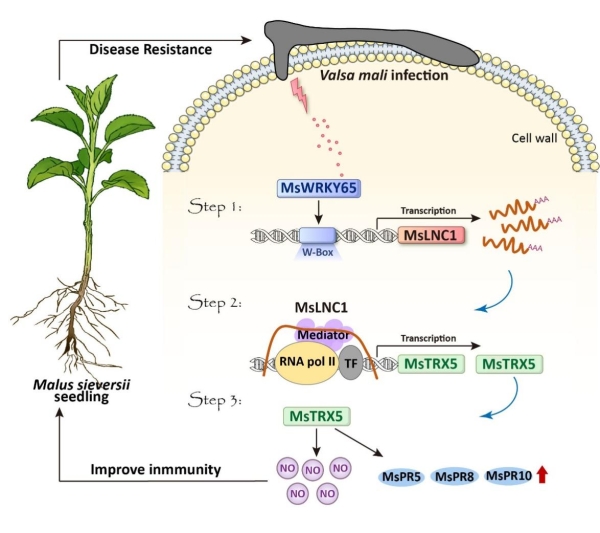
The proposed mode of action of MsWRKY65-MsLNC1-MsTRX5 module. (Image by XIEG)
<関連情報>
- https://english.cas.cn/newsroom/research-news/202608/t20260825_1188818.shtml
- https://academic.oup.com/hr/advance-article/doi/10.1093/hr/uhag299/8739789
新規MsWRKY65– MsLNC1 –MsTRX5モジュールは、野生リンゴ(Malus sieversii) にバルサ病抵抗性を付与する Novel MsWRKY65–MsLNC1–MsTRX5 module confers Valsa canker resistance in wild apple (Malus sieversii)
Xiaojie Liu,Mingqi Zhao,Huawei Liu Jianglin Zhu,Tohir A Bozorov,Xuejing Wen,Yakupjan Haxim,Lili Huang,Zongrang Liu,Daoyuan Zhang
Horticulture Research Published:22 July 2026
DOI:https://doi.org/10.1093/hr/uhag299
Abstract
Valsa mali is a devastating fungal pathogen that causes systemic necrosis and trunk dieback in apple trees, a disease widely known as ‘apple canker’. While this pathogen poses a serious threat to woody plants, the molecular basis of host resistance remains poorly understood. Here, we investigated whether long non-coding RNAs (lncRNAs) contribute to defence against V. mali in Malus sieversii. Through systematic screening, we identified a key pathogen-responsive MsLNC1, 388-nt sense lncRNA. Ectopic overexpression of MsLNC1 enhanced resistance, whereas its knockdown compromised resistance in apple plantlets. MsLNC1 is downstream of MsWRKY65, which exerts its regulatory effect by binding to the W-box motif within its promotor. MsWRKY65 acts as a positive regulator in mediating the resistance of M. sieversii to V. mali. Additionally, thioredoxin H5 (MsTRX5), the neighboring gene of MsLNC1, exhibits a significant resistance function against V. mali. Genetic and molecular evidence demonstrates that MsLNC1, which binds to two 20-bp homologous regions with the MsTRX5 promoter, and physically interacts with RNA Polymerase II (Pol II) components, enhances MsTRX5 transcription. Collectively, our results demonstrate that MsLNC1 functions upstream of MsTRX5 and, together with MsWRKY65, forms a previously uncharacterized regulatory module that controls V. mali resistance in wild apple.