2026-08-27 京都大学
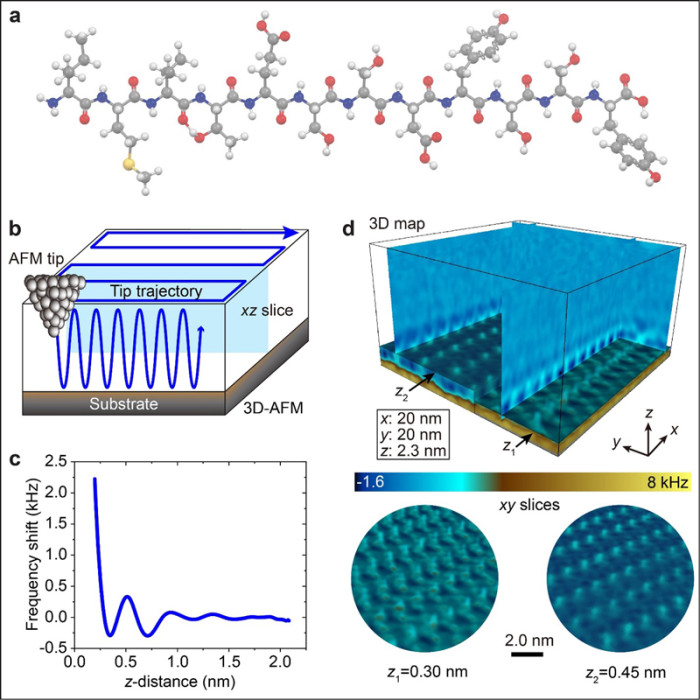
自己組織化したペプチドの水和構造の3D-AFMによる可視化。
<関連情報>
- https://www.kyoto-u.ac.jp/ja/research-news/2026-08-27-2
- https://www.nature.com/articles/s41467-026-76923-4
ペプチドは配列特異的な表面化学によって規定される多層的な水和シェル副構造を示す Peptides display multilayered hydration shell substructures dictated by sequence-specific surface chemistry
Ayhan Yurtsever,Fabio Priante,Linhao Sun,Djamel Eddine Chafai,Kaito Hirata,Keisuke Miyazawa,Leonardo Puppulin,Kazuki Miyata,Takashi Sumikama,Adam S. Foster,Takeshi Fukuma & Mehmet Sarikaya
Nature Communications Published:26 August 2026
DOI:https://doi.org/10.1038/s41467-026-76923-4 Early provide
Abstract
Water is crucial for life, mediating intermolecular interactions that govern protein stability, molecular recognition, and biological function. While insights into protein hydration have been obtained using spectroscopic, scattering, and computational approaches, direct real-space visualization of hydration architectures at biomolecular interfaces with submolecular resolution remains challenging. Here we show that three-dimensional atomic force microscopy directly maps hydration architectures of self-assembled peptide molecular arrays formed on atomically flat graphite. We observe that a graphite-binding dodecapeptide, which mimics structural and chemical characteristics of proteins, organizes water into a multilayered, structured hydration shell. The structured water in the hydration shell exhibits a gradient of molecular ordering that is modulated by sequence-encoded surface chemistry, giving rise to domains of enhanced and diminished water organization that extend across hydration layers before gradually converging into the bulk water. The hydration structure dynamically conforms to the physical topography and the chemical domains of the peptides, with local water structure modulated by hydrophobic, polar, and charged peptide residues. Our findings reconceptualize hydration as a sequence-specific structural phenomenon, defining an integrated protein superstructure that incorporates the amino acid framework and its structured hydration shell, thereby providing a basis for understanding hydration-governed protein function and for designing proteins with tailored functionalities