2026-08-27 京都大学
Pcgf5による「全能性からの脱却」の制御と、全能性幹細胞樹立への展望
<関連情報>
- https://www.kyoto-u.ac.jp/ja/research-news/2026-08-27-0
- https://www.sciencedirect.com/science/article/pii/S0006291X26011812
Pcgf5はマウス胚性幹細胞における全能性からの脱却を制御する Pcgf5 controls the exit from totipotency in mouse embryonic stem cells
Satoshi Mashiko, Shinnosuke Honda, Shuntaro Ikeda, Tomoyuki Tsukiyama
Biochemical and Biophysical Research Communications Available online: 11 August 2026
DOI:https://doi.org/10.1016/j.bbrc.2026.154417
Highlights
- Pcgf5 overexpression reduces MERVL/Zscan4 double-positive 2C-like cells in ESCs.
- Pcgf5 knockout increases the proportion of 2C-like cells.
- FACS of sorted double-positive cells confirms delayed exit upon Pcgf5 loss.
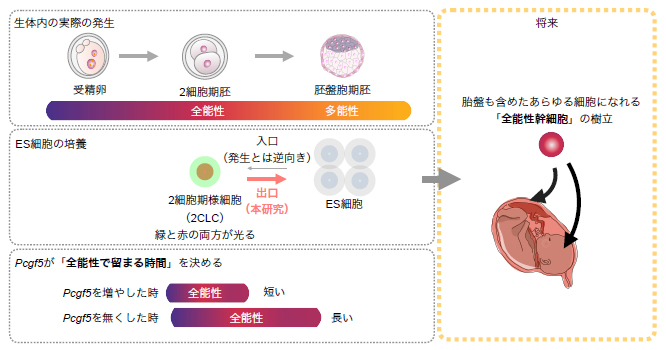
- Pcgf5 overexpression shortens and loss prolongs residence in the 2C-like state.
- Pcgf5 promotes exit, distinct from other PRC1 subunits that gate 2CLC entry.
Abstract
Mouse embryonic stem cell (ESC) cultures contain a rare subpopulation of two-cell-like cells (2CLCs) that transiently reactivate a two-cell embryo–like transcriptional program characteristic of zygotic genome activation (ZGA), including the endogenous retrovirus MERVL and Zscan4, and thereby regain a totipotent-like state. Polycomb repressive complex 1 (PRC1)–mediated H2AK119ub1 has been implicated in restraining entry into the 2C-like state through Pcgf6, yet the factors governing exit from this state and loss of totipotency remain poorly defined. Here, we show that among the six Pcgf paralogs, Pcgf5, which is most prominently upregulated in 2CLCs and forms an MERVL-driven chimeric transcript (Pcgf5MT2C_Mm) during ZGA in 2-cell embryos, controls exit from the 2C-like state in mouse ESCs. Using a reporter ESC line carrying MERVL-tdTomato and Zscan4c-EGFP (MtZG), we manipulated Pcgf5 dosage bidirectionally. Doxycycline (Dox)-inducible overexpression (OE) of Pcgf5 reduced the double-positive (DP) 2C-like population. Conversely, CRISPR-mediated knockout (KO) of Pcgf5 by targeting a common exon shared by all Pcgf5 variants (hereafter, total Pcgf5) increased the DP population. Time-lapse imaging directly confirmed that these changes reflected genuine differences in duration of the 2C-like state: OE shortened, whereas KO prolonged, the time cells spent in this state. These findings reveal that a Polycomb group factor controls not only entry into but also exit from the 2C-like state.