2026-08-28 中国科学院(CAS)
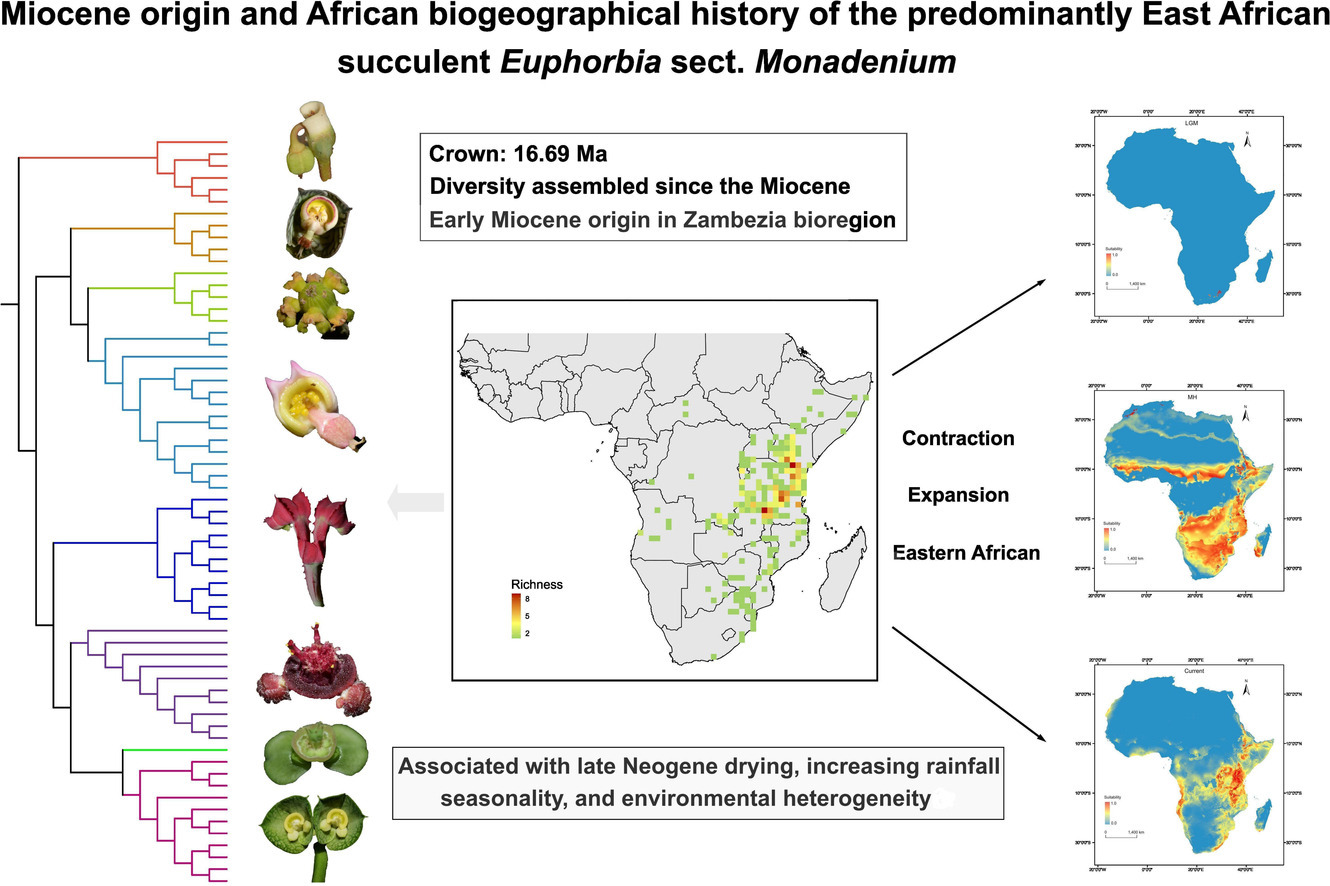
Species richness pattern of Euphorbia sect. Monadenium across Africa based on 100 km × 100 km grid cells (Image by WBG)
<関連情報>
- https://english.cas.cn/newsroom/research-news/202608/t20260828_1189436.shtml
- https://www.sciencedirect.com/science/article/abs/pii/S0031018226004931
主に東アフリカに分布する多肉植物ユーフォルビア属モナデニウム節の起源とアフリカにおける生物地理学的歴史(中新世) Miocene origin and African biogeographical history of the predominantly East African succulent Euphorbia section Monadenium
Neng Wei, Zhao-Hui Ran, Emmanuel Kipkemoi, Ranto Tiana Ratsiferanarivo, Paul M. Kirika, Elijah Nyakudya, Sheng-Wei Wang, Qing-Feng Wang
Palaeogeography, Palaeoclimatology, Palaeoecology Available online: 2 July 2026
DOI:https://doi.org/10.1016/j.palaeo.2026.114030
Highlights
- Early Miocene (16.69 Ma) is the onset of crown diversification within the Euphorbia sect. Monadenium.
- With a Zambezian ancestral range, repeated dispersal and vicariance shaped its diversification in tropical Africa.
- Climatic drying and rainfall seasonality in late Neogene drove ecological differentiation and lineage accumulation.
Abstract
The section Monadenium in the extraordinarily diverse genus Euphorbia is characterized by annular and partially or fully fused cyathial glands, and exhibits striking growth form diversity and high levels of endemism. However, the phylogenetic relationships and biogeographical history of this predominantly East African section remain unresolved. Here, we sampled a total of 81 accessions in Euphorbiaceae, of which 62 plastomes were de novo assembled, including 63 plastomes from 56 species representing approximately 62% of the currently recognized Euphorbia section Monadenium species. Phylogenomic analyses were applied to investigate divergence-time estimation, ancestral ranges, diversification dynamics, ancestral niche reconstruction, and ecological niche modeling. Phylogenetic analyses of the plastome datasets strongly support the monophyly of Euphorbia section Monadenium, allow recovery of the section as sister to the clade comprising section Euphorbia and section Rubellae, and identify eight well-supported internal clades. Divergence-time estimates indicate that the Early Miocene (16.69 Ma) is the onset of crown diversification within the Euphorbia section Monadenium. Ancestral range reconstruction suggests a Zambezian origin, followed by repeated dispersal and vicariance across eastern, south-central, and southern Africa. Diversification analyses reveal progressive lineage accumulation, accelerating from the Late Miocene onward, with persistently low extinction rates. Species richness of Euphorbia section Monadenium is concentrated today in eastern Africa, especially in and around the East African Rift, whereas ancestral range reconstruction supports its Zambezian origin. Principal component analysis and ancestral niche reconstruction indicate that environmental differentiation is mainly driven by precipitation-related variables, especially rainfall seasonality and precipitation during climatically stressful periods. Ecological niche models reveal marked temporal shifts in suitable habitat, including contraction during the Last Glacial Maximum, expansion during the Middle Holocene, and a present-day concentration in East Africa. Collectively, these findings suggest that the extant diversity of Euphorbia section Monadenium was assembled progressively from the Miocene onward, with late Neogene climatic drying, increasing rainfall seasonality, and heterogeneous African landscapes likely contributing to its diversification.