2026-08-31 イリノイ大学アーバナ・シャンペーン校
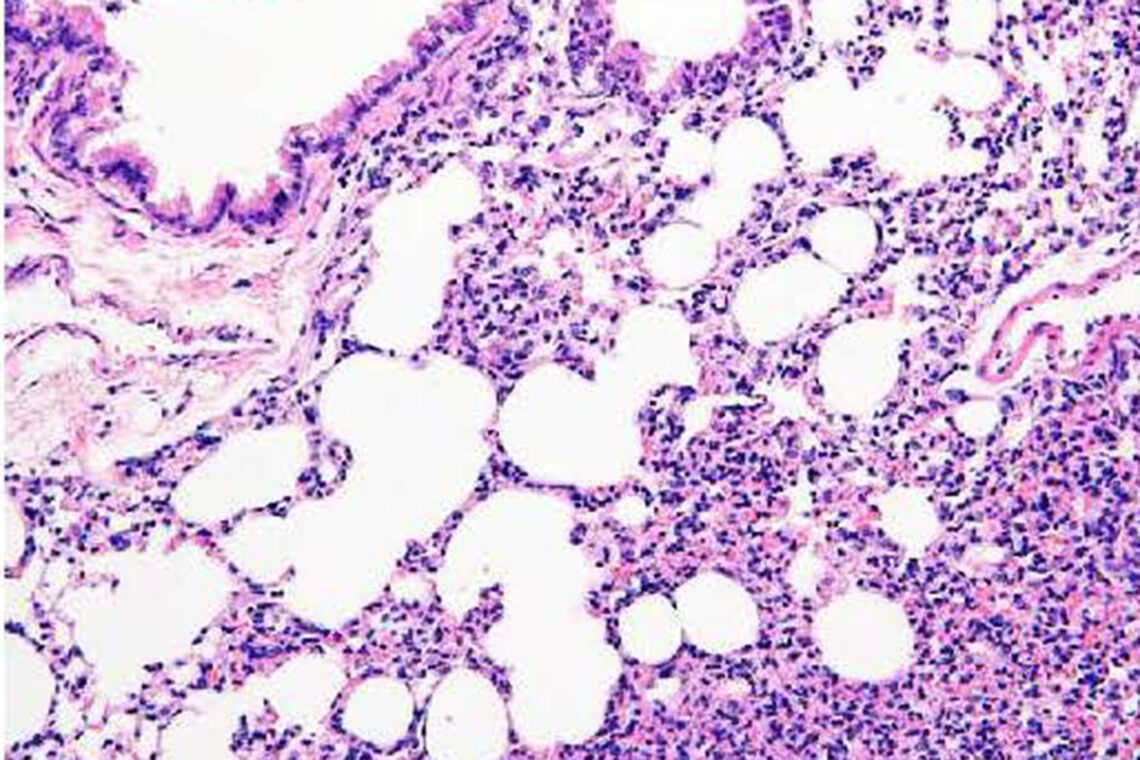
A sample of mouse lung showing pulmonary fibrosis caused by corisin, a protein fragment produced by bacteria in the microbiome. A new study found that corisin disrupts protein-regulating processes in the mitochondria, causing cell death and tissue fibrosis. Image courtesy Esteban Gabazza
<関連情報>
- https://news.illinois.edu/a-bacterial-protein-fragment-drives-tissue-fibrosis-but-antibody-treatment-can-help-study-finds/
- https://www.nature.com/articles/s41467-026-76162-7
コリシンはタンパク質恒常性ストレスを誘導し、上皮損傷と肺線維症を引き起こす Corisin induces proteostasis stress to drive epithelial injury and pulmonary fibrosis
Hajime Fujimoto,Taro Yasuma,Corina N. D’Alessandro-Gabazza,Masaaki Toda,Kota Nishihama,Atsuro Takeshita,Valeria Fridman D’Alessandro,Atsushi Tomaru,Haruko Saiki,Tomohito Okano,Yurie Kogue,Tomoko Anoh,Manal A. B. Alhawsawi,Ahmed M. Abdel-Hamid,Brian Imai,Christopher J. Fields,Jessica Teofanovic,Kyle Leistikow,Ryoichi Ono,Tetsuya Nosaka,Hidetoshi Yamazaki,Daishi Yamakawa,Yasuko K. Bando,Fuminori Sugihara,… Esteban C. Gabazza
Nature Communications Published:01 August 2026
DOI:https://doi.org/10.1038/s41467-026-76162-7
Abstract
Idiopathic pulmonary fibrosis (IPF) is a progressive, fatal disease lacking clarity on the mechanisms linking epithelial injury to fibrotic remodeling. Here, we identify the microbiota-derived corisin as a potent, multifaceted driver of epithelial injury and pulmonary fibrosis. Leveraging targeted DNA sequencing of bronchoalveolar lavage fluid, we provide the first sequence-based identification of corisin in IPF patients and show that functional depletion of native corisin from patient bronchoalveolar lavage fluid abolishes its proapoptotic activity in alveolar epithelial cells. Synthetic corisin readily penetrates epithelial cells, localizes to mitochondria, and induces apoptosis, cellular senescence, and epithelial–mesenchymal transition, effects validated by single-cell transcriptomic analysis. High-throughput protein-interaction screening identifies the ubiquitin–proteasome system as the primary target, demonstrating that corisin enhances proteasome activity and disrupts epithelial proteostasis. Intracellular expression of native corisin recapitulates these cellular pathologies at concentrations relevant to human disease, confirming its high intrinsic potency. Most critically, transgenic mice constitutively expressing native corisin develop spontaneous, progressive pulmonary fibrosis and exhibit exacerbated injury and increased mortality following bleomycin challenge. Collectively, our findings establish corisin as a microbiota-derived effector that directly couples the collapse of epithelial proteostasis to multimechanistic cell-fate dysregulation and fibrotic remodeling, thereby defining a potent and causal microbial–epithelial axis in the pathogenesis of IPF.