2026-08-31 中国科学院(CAS)
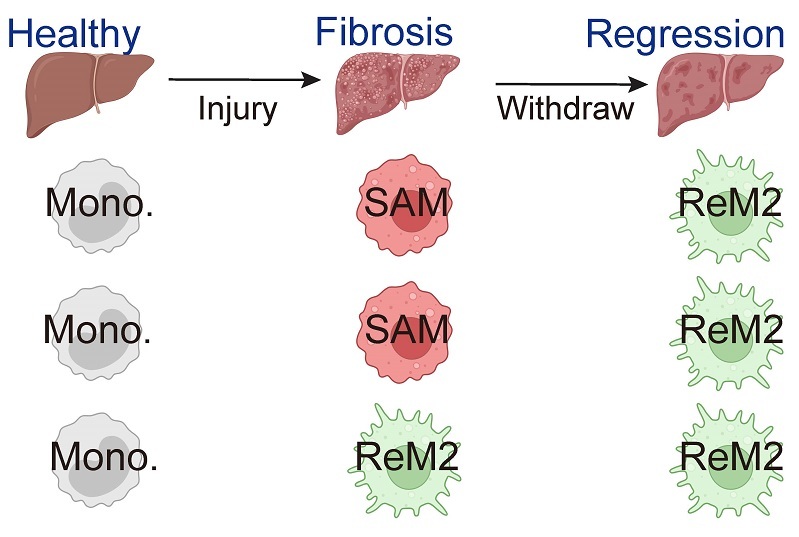
Schematic model of the SAM/ReM2 macrophage populations. Under homeostatic conditions, monocytes are the predominant population. Upon injury, monocytes differentiate primarily into SAMs, accompanied by a small proportion that differentiates toward ReM2. During the recovery phase, SAMs rapidly decline, while ReM2 cells continue to accumulate. (Image by ZHOU Haining’s group)
<関連情報>
- https://english.cas.cn/newsroom/research-news/202609/t20260901_1189590.shtml
- https://www.pnas.org/doi/10.1073/pnas.2611441123
マクロファージは、肝線維化を制御するために、線維化促進性SAM細胞と炎症解消促進性ReM2細胞に分化する Macrophages diverge into profibrotic SAMs and proresolving ReM2 cells to regulate liver fibrosis
Dezhen Zhang, Xinjie Liu, Dong Ma, +8 , and Haining Zhou
Proceedings of the National Academy Sciences Published:August 21, 2026
DOI:https://doi.org/10.1073/pnas.2611441123
Abstract
A central question in liver fibrosis is how macrophages, key regulators of inflammation and tissue repair, are divergently programmed to either promote scar formation or drive its resolution. Here, we identify a macrophage axis that governs this balance. While scar-associated macrophages (SAMs) promote fibrogenesis through cytokine-mediated activation of hepatic stellate cells, a previously uncharacterized macrophage subset, termed ReM2, orchestrates fibrosis regression. ReM2 arises from circulating monocytes following liver injury, accumulates during fibrogenesis, and peaks during the resolution phase. Mechanistically, ReM2-dependent fibrosis regression requires the expression of specific receptors, including FCGR4 and ITGA4, which may mediate this effect by enabling direct recognition and phagocytic clearance of collagen I and fibronectin from the extracellular matrix. These findings reveal a functional divergence of monocyte-derived macrophages that governs fibrosis progression vs. resolution and suggest that therapeutic rebalancing of the SAM–ReM2 axis may represent a promising strategy for treating liver fibrosis.